Article 94
Introducing the Four Quadrants
“Introducing The Four Quadrants.” In this article Westminster investment strategist Peter Lucas discusses the Four Quadrants, a framework we use in our investment process. The Four Quadrants captures different macro variables into four distinct quadrants with each one having different implications for asset allocation.
We live in an era of information overload. Some data is clearly needed to make investment decisions, but too much can obscure the variables that matter most. The challenge is to distinguish useful signals from noise and organise them into a framework that helps us make consistent decisions.
Economic growth and inflation are a good place to start. Growth influences company revenues, profitability and the ability to service debts. Inflation affects selling prices, costs, interest rates and the valuation investors attach to future earnings. Both influence equity returns, but through channels that can reinforce or offset one another.
For investment purposes, changes in inflation matter, but their effect depends partly on the starting level. Moderating inflation from an elevated rate can ease pressure on interest rates and support equity valuations. Rising inflation from already high levels can have the opposite effect. At very low inflation, however, the relationship can reverse: a modest increase may reduce the threat of deflation, while further disinflation can intensify it. Our historical analysis also shows that US equities have generated most of their real returns during periods when inflation was below roughly four per cent.
For growth, the key is whether the economy is expanding or contracting. Accelerating growth can support equities, but an economy does not need to accelerate for companies to prosper. Growth slowing from three per cent to one per cent still represents an expansion. Recession presents a more difficult environment: weaker demand puts revenues under pressure while many operating costs and debt commitments remain fixed. Profits do not move mechanically with GDP, but contraction increases the risk of falling earnings and financial distress.
The relationship between inflation and equity ratings helps explain these effects. Historical comparisons of the S&P 500’s Shiller price-to-earnings ratio with inflation reveal a hump-shaped relationship, with higher ratings around moderate positive inflation and lower ratings at either extreme.
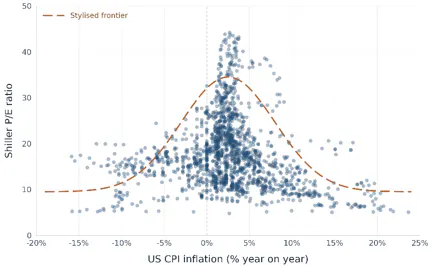
High inflation can bring tighter monetary policy and greater uncertainty over future profits. Very low inflation or deflation can raise concerns about weak demand, squeezed margins and the burden of debt. Investors may therefore pay less for earnings in either environment, leaving a sweet spot for valuations around two to four per cent. This helps explain why rising inflation is particularly problematic for equity valuations when it is already above that range. Conversely, disinflation towards the sweet spot can support a rerating.
Earnings provide the other part of the framework. Equities can perform well despite accelerating inflation if profits rise sufficiently to offset a lower valuation multiple. Conversely, falling inflation may offer little comfort if earnings are contracting sharply. This is why growth and inflation need to be assessed together. The implications of one depend partly on what is happening to the other.
Combining expansion or recession with accelerating inflation or disinflation creates four economic quadrants. Disinflation during expansion can support both earnings and ratings; during recession, it can accompany falling profits and favour safe government bonds instead. The framework captures these interactions in four distinct environments, each with different implications for asset allocation. Its simplicity helps us focus on the dominant economic forces without dividing history into more scenarios than the evidence can reliably support.
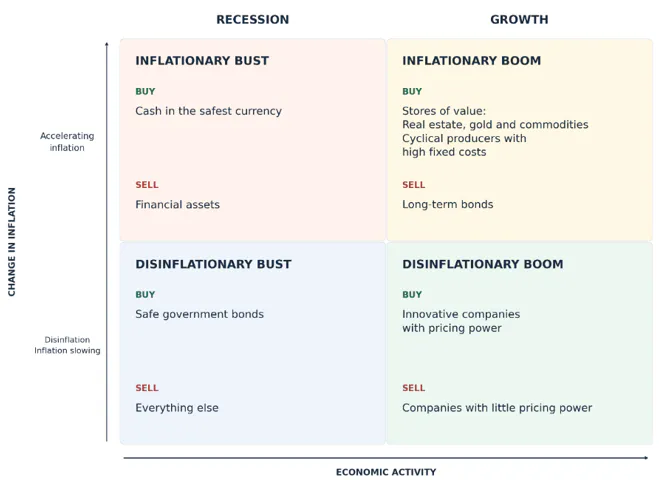
The diagram is straightforward. Establishing which quadrant is in force in real time is considerably harder. Economic statistics arrive with delays, are frequently revised and can give conflicting signals. Markets also anticipate events: waiting for definitive evidence of recession may mean responding after asset prices have already adjusted.
Our process therefore distinguishes between describing the economy and identifying conditions relevant to investment decisions. An indicator can provide an accurate account of current activity without offering sufficient warning of a change in the investment environment. Equally, a timely warning is of limited use if it repeatedly signals downturns that fail to materialise. The challenge is to balance responsiveness with reliability.
At Westminster, we use a systematic assessment of growth and inflation to inform the quadrant classification. The detailed methodology is proprietary, but the questions behind it are straightforward. Does an indicator have a credible economic rationale? Does it provide useful information using only data available at the time? Does its behaviour hold across different economic episodes, rather than depend on one unusually successful period?
Combining the signals provides a consistent basis for assessing the environment and its implications for asset allocation. It does not eliminate uncertainty or make every turning point predictable. It does, however, make the reasoning behind allocation decisions explicit and repeatable, reducing the temptation to reinterpret the economic picture to suit an existing investment position.
Our indicators currently place the US economy in an inflationary boom. Within this framework, that favours commodities and selected cyclical and value equities, while presenting greater challenges for long-term government bonds. My expectation is that the next major transition will be towards an inflationary bust, although I suspect that remains some way off. In the meantime, we will continue to monitor the evidence and adjust allocations accordingly.