Article 93
Battle of the Bonds
The next major phase in financial markets may be defined by a confrontation between governments that cannot comfortably afford higher borrowing costs and investors who increasingly demand them. Inflation is accelerating, yields are rising and the political appetite for fiscal restraint remains limited. But the resulting crisis need not unfold everywhere simultaneously. Europe’s difficulties could initially extend America’s boom before contributing to its eventual bust.
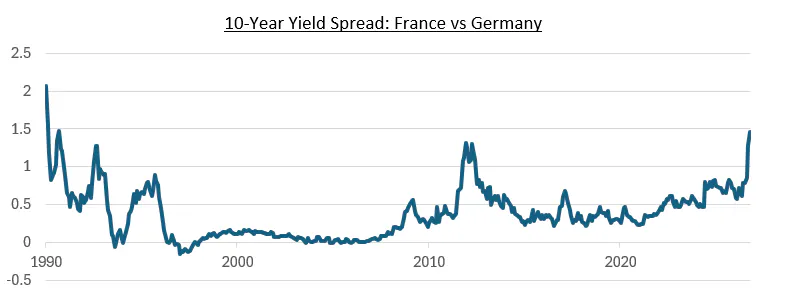
France is the key country to watch. With high levels of private and public sector debt, France appears to be heading towards a day of reckoning. The arithmetic is painful. When the average interest rate on government debt exceeds nominal GDP growth, stabilising the debt ratio requires a primary surplus: revenues exceeding spending before interest. Persistent primary deficits compound the problem. Existing fixed-rate debt provides temporary protection, but as cheap borrowing matures, higher financing costs become increasingly problematic.
Spending restraint, higher taxes and productivity reforms could restore confidence. Yet these impose visible costs or take time. If rising yields threaten public finances, banks, pensions and property markets simultaneously, pressure to intervene will become formidable.
Policymakers have several tools. Quantitative easing involves central banks buying bonds with newly created reserves, potentially lowering yields and encouraging investors to seek returns elsewhere. Yield-curve control goes further: the central bank specifies the yield it will defend and buys whatever is necessary.
When Mario Draghi pledged to do “whatever it takes” in July 2012, eurozone inflation was 2.4%, modestly above the ECB’s objective and expected to decline. His promise, backed by a conditional bond-buying framework, helped restore confidence without that programme being activated. Today, headline inflation is 3.8%, up from 3.2% in August. The ECB would therefore be intervening against a backdrop of inflation well above target and accelerating. Suppressing borrowing costs could undermine the restraint needed to bring inflation down, while tolerating higher yields could intensify sovereign stress. That conflict makes the backstop harder to defend credibly. I doubt investors will be appeased so easily this time. Actual purchases would be likely to weaken the euro and reinforce the inflationary pressures complicating the rescue.
Governments can also direct banks, insurers and pension funds towards public debt through investment mandates, regulations and tax incentives. Such financial repression creates demand without necessarily creating money. Its costs include lower returns for savers, reduced funding for productive investment and greater dependence between governments and financial institutions.
Capital controls would attempt to prevent investors escaping these arrangements, but at considerable cost to confidence and financial flexibility. France also cannot independently create euros: any central-bank backstop depends on collective European decisions and conditions.
Not every intervention is inflationary. The Bank of England’s emergency gilt purchases in 2022 were temporary and subsequently reversed. The danger arises when support becomes persistent, deficits continue and monetary policy becomes subordinate to keeping governments financed. Then a destructive feedback loop becomes possible. Rising yields trigger intervention. Intervention weakens pressure for fiscal adjustment and accommodates continued borrowing; inflation concerns intensify, investors demand greater compensation and policymakers intervene again. If yields remain capped, pressure emerges through heavier purchases, currency weakness or higher borrowing costs elsewhere.
As I have consistently argued, the outlook for Europe is troubling. But what is bad for Europe need not immediately be disastrous for the rest of the world. Consider the Asian crisis of 1997–98. America suffered trade losses and bouts of market turmoil, particularly during the subsequent Russian default and LTCM crisis. Yet capital flowed into dollar assets, Treasury yields fell and cheaper imports and commodities helped contain US inflation. Federal Reserve research found that lower interest rates more than offset the adverse trade effects on American growth. Those conditions helped sustain the American expansion and provided a supportive backdrop to the technology boom.
Could a European debt crisis play a similar role? Despite America’s obvious fiscal failings, it would be the natural destination for investors escaping European uncertainty and repression. Capital could flow into Treasuries, equities and other US assets. Investors need not regard America as financially virtuous to consider it preferable to the alternatives. The resulting dollar strength could reduce US import-price pressures, while safe-haven demand would support Treasuries. Capital inflows combined with easing interest-rate concerns would be a heady cocktail for American stocks. Europe’s crisis could temporarily conceal America’s vulnerabilities by supplying the money that sustains its markets and finances its government.
There is, however, an important difference from 1997. The Asian crisis depressed commodity prices. Given persistent supply constraints and European intervention, commodity prices will likely prove more resilient this time around. America could enjoy capital inflows without receiving the same disinflationary dividend.
A weakening euro combined with resilient dollar-denominated commodity prices would raise import costs and squeeze purchasing power. Weaker real growth and pressure for compensatory government spending could intensify fiscal strain, prompting further intervention.
For investors, this divergence could be rewarding. US equities could benefit from incoming capital, while gold could attract those seeking protection beyond any government’s promise to pay. Resource producers and businesses supplying scarce energy, materials and infrastructure could prosper if nominal spending remained strong.
These opportunities would be selective. A stronger dollar could hurt US exporters and overseas earnings, while tightening conditions for vulnerable emerging economies. European bank retrenchment and weaker import demand could transmit stress internationally. Higher nominal revenues would not guarantee higher real profits.
Nor would America’s reprieve necessarily last. Capital inflows might postpone its fiscal reckoning without resolving it. Persistent commodity inflation, heavy borrowing requirements or declining confidence could eventually outweigh safe-haven demand and push Treasury yields higher again.
At that point, rising financing costs and a strong dollar could become a damaging combination: the former undermining valuations and leveraged borrowers, the latter squeezing exporters and dollar debtors. An extended boom could give way to another period of financial instability.
If the Federal Reserve were then to resume sustained bond purchases while fiscal deficits and supply constraints persisted, the commodity bull market could gain a much stronger monetary impulse, with the euro and the US dollar both losing purchasing power against real assets.
The investment challenge is to recognise that sequence: Europe’s crisis may first fuel an American boom before the defence of government debt becomes a broader crisis of purchasing power.