Article 91
The next Euro debt crisis: FREXIT or DEXIT?
In this article Westminster investment strategist Peter Lucas considers where the next Eurozone debt crisis might come from and asks a provocative question: could France trigger the crisis, only for Germany to become the first of the euro’s two principal architects to leave the single currency?
I have been sceptical about the sustainability of the euro from the start. However, I underestimated the ability of member countries to hold things together with policy fudges and quantitative easing. But as time has gone by, I have become more, not less, convinced that it will fail, and my focus has shifted to the detail: which of the two principal architects of the euro will leave first: France or Germany?
It sounds like an extreme question. And today, it probably is. Neither country is close to leaving the single currency and, without another sovereign-debt crisis, there is little reason for either country to contemplate doing so. But the risks of another such crisis are rising. And if one comes, events could move remarkably quickly.
Interestingly, France and Germany could ultimately be pushed towards the exit for completely opposite reasons. France’s problem is debt. Germany’s problem is inflation. It is a tension that has existed since monetary union began. France has generally favoured greater fiscal flexibility and political discretion; Germany has traditionally insisted upon sound money and fiscal discipline.
So far, compromise has kept the show on the road. The next debt crisis could make that much harder. The French bond market is already sending a warning. Not only is France’s 10-year spread with Germany the widest it has been in years, but French bond yields are now above those of Spain, Italy and even Greece. That is a remarkable reversal. For most of the euro’s existence, Southern Europe was considered its soft underbelly, while France occupied the privileged Franco-German core.
That distinction is rapidly disappearing. French government debt is approaching 120% of GDP, its budget deficit remains above 5%, and public expenditure is among the highest in the developed world. Worse, there is little political appetite for the sustained fiscal tightening required to stabilise the debt burden.
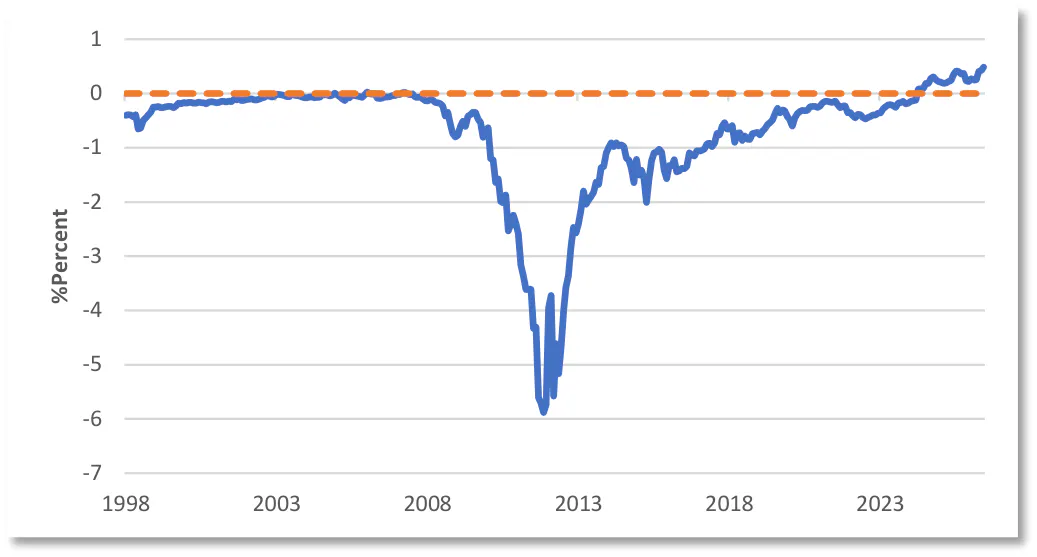
And France’s debt problem extends well beyond the government. It combines one of the developed world’s highest levels of public and private debt with a negative net international investment position. Unlike other heavily indebted economies such as Japan, France cannot point to a vast stock of net foreign assets as an offset.
France can just about live with current borrowing costs. The danger comes if bond yields continue to rise. Higher yields increase debt-servicing costs, worsening the fiscal outlook and potentially driving yields still higher. Confidence can disappear much faster than fiscal fundamentals deteriorate.
That vulnerability will rise as the 2027 presidential election approaches. Marine Le Pen is now the clear frontrunner, leading comfortably in first-round polling and increasingly competitive in hypothetical second-round contests. A Le Pen presidency should therefore be regarded as a central scenario rather than an exotic political risk.
This does not mean France is about to leave the euro. Rassemblement National abandoned that policy some years ago. Arguably, that makes a potential confrontation with Germany more interesting. A future French government could insist upon remaining inside the euro while rejecting the fiscal consolidation demanded by Brussels or financial markets.
France has form here. In 2003, France and Germany breached the Stability and Growth Pact and effectively prevented its enforcement. A future president facing an electorate hostile to austerity may similarly conclude that forcing Europe to accommodate France is politically much easier than forcing France to accommodate Europe. The last sovereign-debt crisis was principally a crisis of the Eurozone periphery. Greece could be threatened with exclusion because it was small. Even Italy, despite the size of its bond market, was not one of the main countries around which the European project had been constructed.
France is different. It is one of Europe’s largest economies and sovereign bond markets, possesses a systemically important banking sector and, most importantly, is one half of the Franco-German partnership that has driven European integration for decades. France is not merely too big to fail. It may be too important to discipline.
During the Greek crisis, Europe said: accept the conditions attached to financial assistance or risk leaving the euro. But try saying that to France. A euro without France would bear little resemblance to the political project created three decades ago. And this is where a French debt crisis could become a Eurozone crisis.
The ECB has powerful tools at its disposal. But its Transmission Protection Instrument is not supposed to provide unconditional financing to governments pursuing unsustainable fiscal policies. Eligibility includes compliance with the European fiscal framework and consideration of debt sustainability.
Imagine a future French government refusing to tighten fiscal policy. OAT yields rise sharply, French banks come under pressure and contagion spreads. The ECB would face enormous pressure to intervene, yet the policies causing the crisis could simultaneously undermine the justification for intervention. Would the ECB really allow the French sovereign market to spiral out of control? Almost certainly not. But if it suppressed the risk premium created by French fiscal policy, monetary policy would increasingly look like it was underwriting the fiscal choices of a member government. Solving France’s problem could create another one in Germany.
Germany’s potential objection to monetary union is about sound money. The original German bargain was that the ECB would resemble an enlarged Bundesbank: price stability would dominate, monetary financing would be prohibited, and countries would remain responsible for their own debts. Successive crises have blurred those principles.
Germany has accepted these compromises because the alternative appeared worse. But imagine another sovereign-debt crisis occurring while inflation remained uncomfortably high. France would demand lower real interest rates, support for its bond market and greater tolerance of fiscal deficits. Germany would want tighter monetary policy and fiscal restraint.
The ECB cannot simultaneously provide both. Rescuing France could require monetary policy considerably looser than German domestic conditions warranted. The more aggressively the ECB acted to keep France inside the euro, the greater the risk that German voters concluded the currency no longer served their interests.
Until recently, this could largely have been dismissed as an academic thought experiment. The rise of the AfD makes it less so. The party has just won close to 44% of the vote in Saxony-Anhalt. It remains some distance from controlling the federal government, but it can no longer be dismissed as a marginal protest movement. And unlike Marine Le Pen, the AfD explicitly advocates German withdrawal from the euro.
Imagine the politics during another debt crisis. German voters are told that French bonds must be supported, fiscal rules relaxed and perhaps greater liabilities shared across Europe because otherwise the single currency could collapse. The AfD offers a different answer: leave, restore monetary independence, and stop underwriting the debts of others.
The obvious answer to the question of who leaves first would seem to be France, but it could well be Germany. Leaving the euro would be enormously disruptive for France. A new franc would probably depreciate sharply, threatening capital flight and banking instability. Alternatively, France could stay and use its enormous political weight to force the Eurozone to accommodate it.
Germany faces the mirror image. A new Deutschmark could appreciate, hurting exporters and generating substantial financial disruption, but Germany would regain control over monetary policy. Meanwhile, the remaining euro would become a much softer currency dominated by France, Italy and Spain - arguably a more natural monetary grouping than today's combination of northern creditors and highly indebted southern economies.
There is also an important investment implication. It has become fashionable to regard America's enormous fiscal deficits and rising government debt as an inevitable recipe for dollar weakness. In the long run, that may prove correct. But currencies are relative prices. America does not need good fiscal fundamentals for the dollar to appreciate. Its problems merely need to be less immediate than those confronting its competitors.
If the global debt crisis reignites in Europe, the initial reaction will likely be a strong dollar. A French exit would almost certainly weaken the euro substantially. A German exit could have an even clearer effect. A new Deutschmark would presumably appreciate, but the residual euro - transformed into a predominantly French and southern European currency - would probably trade substantially below today's levels against the dollar.
Only after the debt crisis has fully played out might attention turn decisively towards America's own fiscal arithmetic. The dollar bears may therefore ultimately be right, but badly wrong about the sequence. Before investors abandon the dollar because of America's debts, they may first rush into it because of everybody else's.
Neither France nor Germany is about to leave the euro. Another sovereign-debt crisis would almost certainly have to come first. But France's deteriorating fiscal position, the political ascendancy of Marine Le Pen, Germany's increasing political fragmentation and the return of inflation risk suggest that the ingredients for the next confrontation are falling into place.
For most of its existence, the existential threat to the euro was assumed to lie on its periphery. The next crisis could be very different. France may force the Eurozone to choose between fiscal discipline and preserving the single currency. Germany may then have to decide whether the resulting currency is still one it wants to belong to. In short, the debt crisis may begin in France. The bigger question is where it ends.