Article 87
When Governments Become the Risk
Westminster Asset Management Investment Strategist Peter Lucas believes we are nearing a point of no return for many developed world governments. Peter has long argued that debt addicted governments and government bond markets are heading for a reckoning, and he considers that moment is approaching with significant implications for portfolio construction ahead.
In 2014, I argued that the global economy was merely passing through the "eye of the storm". The combination of exceptionally low inflation, near-zero interest rates and abundant liquidity that followed the Global Financial Crisis was not a new economic paradigm but a temporary respite. The underlying fragility created by ever-rising debt had not disappeared. It had simply been masked by unprecedented monetary stimulus.
Over the subsequent decade, that framework evolved as events unfolded. In 2021, I highlighted the vulnerability of the traditional 60/40 portfolio to a return of inflation. In 2022, I argued that the forty-year bull market in government bonds had come to an end and that investors were entering a structurally more inflationary world. More recently, I suggested that the initial surge in bond yields would be followed by a period of consolidation before the next significant move higher.
I now believe we are entering that next phase. Inflation remains above target across much of the developed world, reflecting, in part, ongoing geopolitical tensions in Ukraine and the Middle East. Yet long-term bond yields continue to rise despite stable policy rates. Investors are beginning to look beyond monetary policy and focus instead on fiscal sustainability.
With debt exceeding 100% of GDP in many developed economies, and bond yields now above nominal GDP growth, the arithmetic is becoming increasingly uncomfortable. The US 30-year Treasury yield has just exceeded the highs recorded in October 2023, May 2025 and May 2026. It is too soon to call this a decisive breakout, but the warning signs are becoming difficult to ignore.
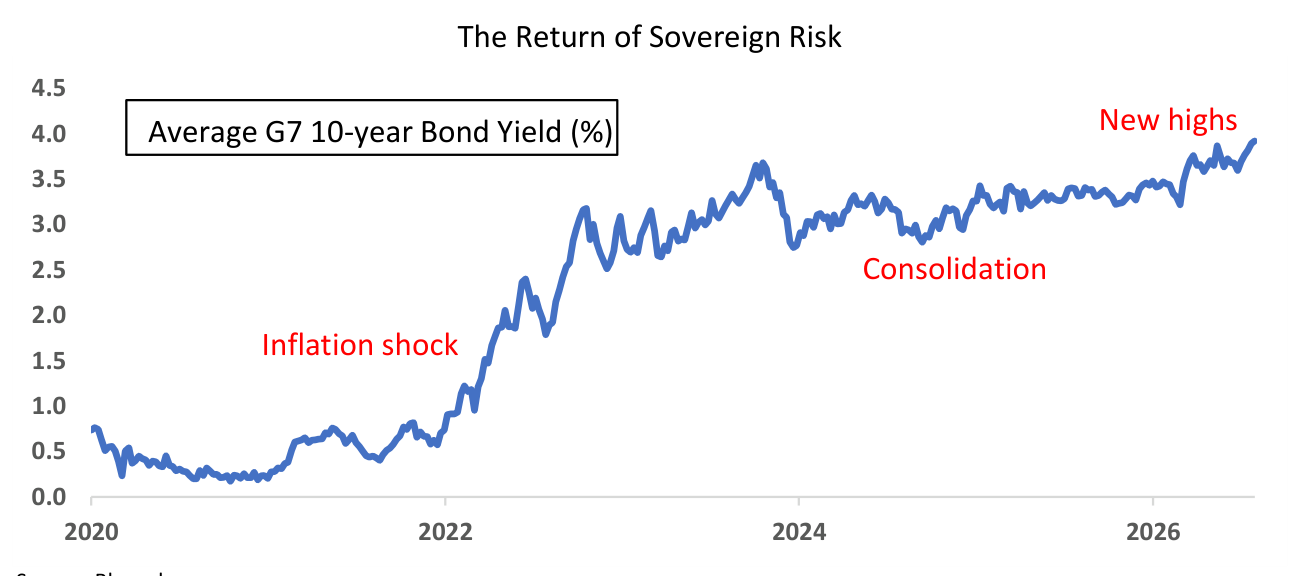
The G7 10-year bond yield chart is telling a similar story. Between 2020 and 2023 the average G7 yield rose from 0.17% to a high of 3.93%. In keeping with my consolidation forecast, bond yields then went sideways for 2-3 years – a disappointingly weak recovery after the worst bond bear market on record – before breaking upwards in March of this year.
We now appear to be entering a very different investment environment. In 2020 investors underestimated inflation risk coming out of COVID. In 2021 they underestimated interest rate risk as central banks were forced to normalise monetary policy. Now I suspect they are underestimating sovereign debt risk, as rising interest rates blow a hole in government finances.
For much of the past two decades, government bonds were treated as the closest thing to a risk-free asset. Investors thought that inflation would remain subdued, central banks would suppress bond yields whenever markets came under stress, and governments could borrow almost without constraint. Those assumptions will be severely challenged in the years ahead. The debt arithmetic is certainly uncomfortable.
Governments across the developed world continue to run substantial fiscal deficits despite relatively healthy economies. Ageing populations are increasing spending on pensions and healthcare. Defence budgets are rising in response to a far more dangerous geopolitical backdrop. At the same time, refinancing costs have increased dramatically compared with the era of ultra-low interest rates.
Higher borrowing costs increase governments' interest bills. Larger interest bills widen budget deficits. Wider deficits require greater debt issuance. Greater debt issuance places further upward pressure on bond yields. The countries most exposed will not necessarily be those with the highest debt ratios. More important is the combination of heavy borrowing requirements, weak economic growth and political paralysis.
France increasingly stands out. The spread between French and German government bond yields has widened back towards the upper end of the range seen since the Eurozone sovereign debt crisis. At the same time, the CAC 40 has persistently underperformed both broader European and global equity markets. While France is far removed from the circumstances faced by Greece a decade ago, investors appear to be demanding a growing premium for holding French assets. It is an early reminder that markets are beginning to discriminate between sovereign borrowers again.
All of this leaves policymakers facing an increasingly uncomfortable dilemma: prioritise inflation and risk destabilising government finances, or intervene aggressively through quantitative easing, yield-curve control or other forms of financial repression and risk worsening the outlook for inflation. Welcome to the world fiscal dominance – see “The age of fiscal dominance” (September 2025) for more details.
In 2022, when the Liz Truss mini-budget triggered a violent sell-off in gilts, there was an abrupt policy reversal and emergency intervention by the Bank of England. In that case, confidence was quickly restored because the crisis was confined to a single country. A global loss of confidence in sovereign debt would present a very different challenge. The issue is no longer whether central banks understand the inflation problem. It is whether they retain the political freedom to prioritise inflation over the solvency of heavily indebted governments.
There are tentative signs that the global monetary landscape may be evolving in other ways. The Chinese renminbi has shown impressive resilience in the face of reducing interest rate support. It is far too early to draw firm conclusions, but if stronger Asian currencies become a sustained trend, they would help insulate Asian economies from imported inflation while simultaneously increasing the cost of manufactured imports for Western consumers. Such a development would reinforce rather than alleviate inflationary pressures in the developed world.
In the early stages, rising bond yields tighten financial conditions. Liquidity becomes scarcer, long-duration assets remain under pressure and even commodities might struggle despite increasingly supportive long-term fundamentals. Eventually, however, borrowing costs will reach levels that governments will find politically or economically unacceptable.
History suggests that heavily indebted sovereigns rarely tolerate permanently high real interest rates. The form of intervention may vary – from quantitative easing to regulatory pressure on domestic institutions or more subtle forms of financial repression – but the objective remains the same: reducing the real burden of public debt.
Ironically, the policies introduced to stabilise bond markets may ultimately undermine confidence in fiat currencies and government paper. That is why I believe investors should think of the next phase not simply as a bond market story, but as a transition in market leadership. For much of the past forty years, falling interest rates rewarded financial assets. Equities outperformed commodities. Bonds almost kept pace with equities.
If governments are indeed becoming the principal source of financial risk, that hierarchy may ultimately reverse. The first phase of this transition has been characterised by rising bond yields and tightening liquidity. The second will be defined by the policy response.
When that moment arrives, the biggest beneficiaries are unlikely to be the government bonds policymakers seek to support. Instead, investors may once again place a premium on assets whose value cannot be created by government decree: energy, industrial commodities, precious metals and businesses with pricing power and tangible assets.
For more than forty years investors have assumed that government bonds have been regarded as the foundation upon which diversified portfolios should be built. The next decade may force them to confront a far more uncomfortable possibility – that governments themselves have become the greatest source of financial risk.