Article 89
Next Phase of the Global Debt Endgame Begins
Westminster Investment Strategist Peter Lucas argues that the next phase of the global debt endgame has begun. He examines the US Treasury’s decision to step up purchases of long-dated government bonds, why it could mark the start of a broader attempt to suppress borrowing costs, and the implications for currencies, inflation and real assets.
For years, I have argued that the enormous accumulation of government debt would ultimately end in financial repression and inflation. The logic is straightforward. There comes a point at which heavily indebted governments can no longer tolerate the interest rates demanded by bond markets. They then face a choice between accepting the fiscal discipline imposed by higher borrowing costs or intervening to suppress them. I have always expected them to take the latter path.
In 2020, I argued that inflation and financial repression were “almost certainly where we are heading”. Last year, in The Next Inflation Wave, I warned that “any attempt to cap bond yields” through low interest rates, quantitative easing or capital controls would push inflation higher. And in March this year I argued that explicit or implicit yield control would mark a further drift towards financial repression.
On Wednesday, the US Treasury unexpectedly announced that it would at least double the size of its liquidity-support buybacks of longer-dated Treasury securities. Purchases in the 10-to-30-year sectors will increase from a maximum of $2 billion to at least $4 billion per operation. This announcement came after the 30-year Treasury yield had reached 5.34%, its highest level since 2007.
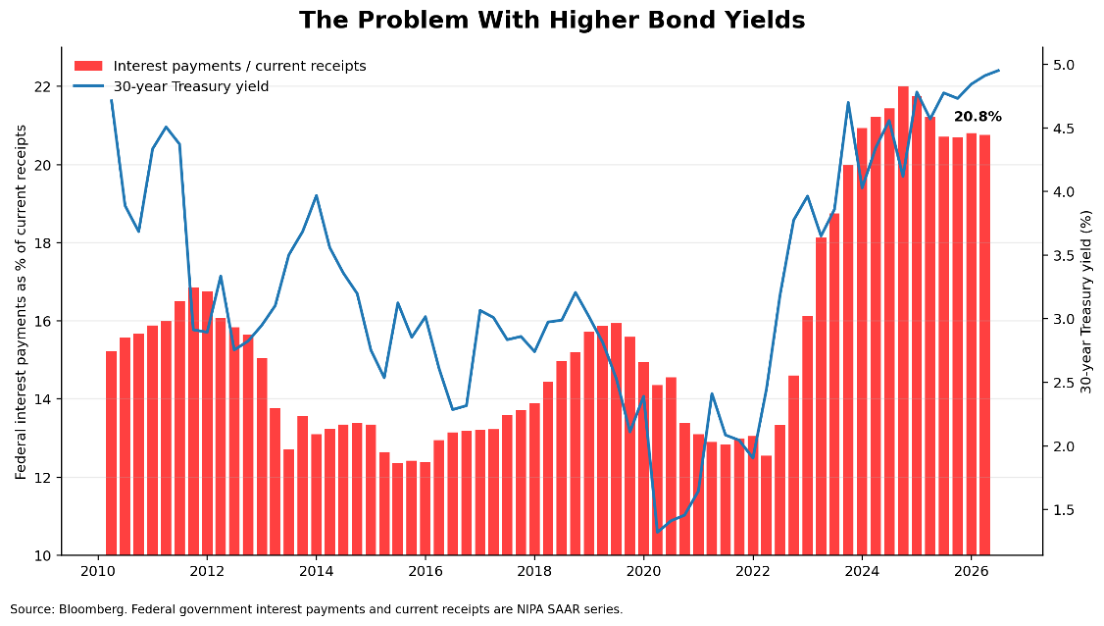
The amounts involved are tiny relative to the size of the Treasury market. This is not quantitative easing, and it is not formal yield-curve control. But the size of the intervention is not the point. What matters is what the decision tells us about the US government's pain threshold. Long-term borrowing costs had risen to uncomfortable levels and the Treasury responded by increasing its buybacks of long-dated government debt. America has more than $40 trillion of government debt, continues to run large fiscal deficits and faces growing debt-servicing costs. If investors increasingly demand higher yields to finance that borrowing, the arithmetic becomes progressively more uncomfortable.
There is no easy answer. Higher taxes or lower government spending could improve the fiscal position, but doing enough to stabilise the debt burden would carry considerable economic and political costs. Faster real economic growth would be preferable, but cannot simply be summoned into existence.
The politically easier option is to make the debt easier to carry, which means keeping interest rates below where they might otherwise be. Markets appeared to understand the significance of Wednesday's move. Thirty-year yields fell, the dollar weakened and precious metals surged. That is exactly how I have expected the next phase of the debt endgame to begin.
But America's decision has implications elsewhere. If US interest rates are held below where the market would otherwise set them, one likely consequence is a weaker dollar. And every exchange rate has two sides. On Wednesday the dollar index fell around 0.8%, while the euro rose by almost 0.9% against the dollar.
For Europe, that could hardly come at a worse time. Its economy already faces a serious competitiveness problem. Productivity growth is poor. Regulation is burdensome. High energy costs and net-zero policies have placed European industry at a competitive disadvantage. Generous welfare systems absorb a large proportion of national resources and ageing populations threaten to increase that burden further. Europe must now also finance substantially higher defence expenditure, adding further pressure to already stretched public finances. A significantly stronger euro is therefore the last thing Europe needs.
Europe will have to decide how much pain it is prepared to tolerate. Indeed, my expectation has always been that no major Western economy would willingly become the fall guy in a global currency adjustment. If America eases financial conditions and the dollar falls, Europe faces pressure to respond. If Europe responds, the pressure moves elsewhere. As one country eases, its currency weakens and other countries are forced to introduce countermeasures. And so begins the race to the bottom.
To be clear, what I envisage is a world in which major Western currencies essentially range-trade against each other, while collectively depreciating against real assets and the undervalued currencies of Asia and Latin America. Although the dollar might lead the way down initially, Europe is where I expect the real fireworks to take place.
That is the essence of financial repression. Governments don't default in the conventional sense. They continue paying their debts, but do so in money that is progressively worth less.
In commodity markets, gold is leading the way, as it so often does. But I expect the rest to follow as financial repression spreads and investors cotton on to what is happening.
This process will not unfold in a straight line. Bond yields will rise and fall, currencies will periodically reverse direction and policymakers will insist that individual interventions are technical rather than part of some grand strategy.
But that misses the bigger picture. For years, the question has been what governments would do when the bond market finally demanded interest rates that their increasingly indebted economies could not comfortably afford. This week, America gave us the first answer. It intervened. The next phase of the debt endgame has begun.