Article 84
What Britain Should Learn From Argentina
Following the recently concluded sporting event in the US, Westminster Asset Management Investment Strategist Peter Lucas considers Argentina. Not the beautiful game, but Argentina’s macro situation. A country living beyond it means for many years, with stark lessons for Britain.
England's defeat to Argentina in the World Cup semi-final was disappointing. It also prompted a rather more uncomfortable thought. What if Argentina is beginning to win a far more important contest? Not football, but economics.
Throughout my career, Argentina has been the textbook example of how nations become poorer. At the beginning of the last century, it was one of the world's richest countries. Average incomes exceeded those of France and Germany, and Buenos Aires rivalled Europe's great capitals. Today it is synonymous with inflation, currency crises and sovereign defaults. How did it fall so far?
The answer was not one bad government or one unfortunate crisis. It was the gradual accumulation of perverse economic incentives. Governments spent more than they raised in taxes. Budget deficits became permanent. Central banks printed money to finance them. Exchange controls, price controls and subsidies attempted to disguise the symptoms rather than address the causes. Investment declined, productivity stagnated and living standards steadily fell.
Every crisis brought more intervention designed to postpone the inevitable adjustment. It never worked. Juan Perón's legacy was not simply the expansion of the state but a political economy in which ever more people became dependent on government spending and protection, making reform increasingly difficult. Eventually, however, the bill arrived.
Britain is, of course, different. It benefits from institutions that have earned investors' confidence over centuries: secure property rights, deep capital markets, an independent judiciary, a respected central bank and constitutional stability. These strengths allow Britain to absorb policy mistakes that would trigger crises elsewhere. They do not, however, suspend the laws of economics.
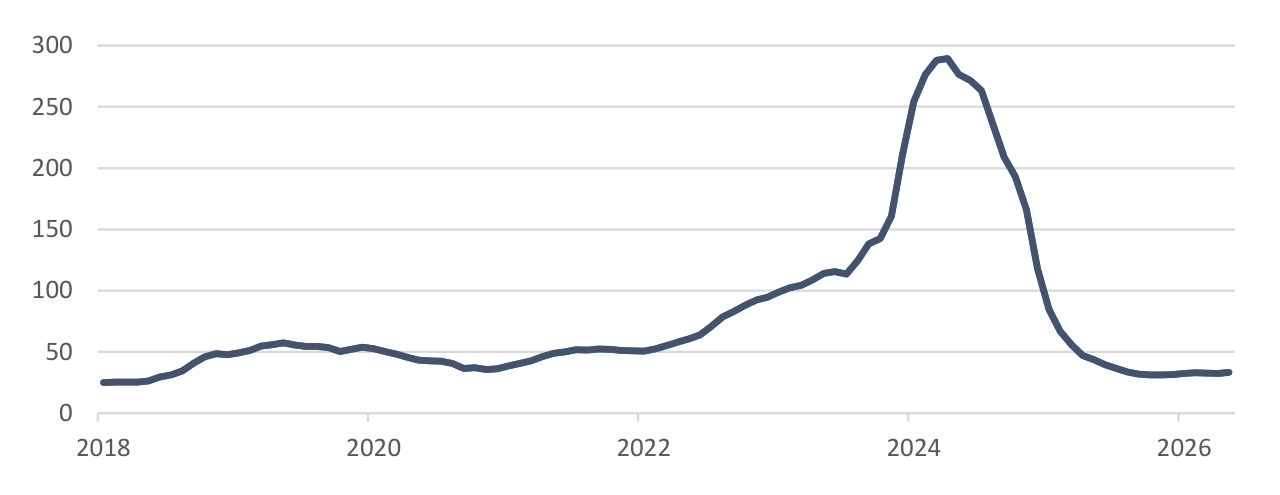
By the time Javier Milei took office in December 2023, Argentina's post-war economic model had reached breaking point. Triple-digit inflation, chronic fiscal deficits, multiple exchange rates and collapsing confidence reflected decades of intervention.
The reforms have been severe. Government spending has been cut sharply, subsidies reduced, price controls dismantled and the central bank has largely stopped financing government deficits. Critics point to the resulting pain as evidence that reform has failed, but they are mistaken. Much of today's pain is the accumulated cost of yesterday's mistakes. Economic reform has simply forced those costs into the open. Like chemotherapy, the treatment often makes the patient feel worse before they feel better. That does not mean the treatment is failing. If governments balance their budgets, stop printing money and allow markets to allocate resources more efficiently, confidence gradually returns. Capital flight slows, inflation falls, investment recovers and, ultimately, real wages and living standards begin to improve.
Argentina has not yet completed that journey, and it may still fail. History offers many examples of governments abandoning reform before its benefits became visible. Margaret Thatcher herself might well have lost office before
Britain's recovery had the Falklands War not intervened. Economics and politics do not always run on the same timetable.
The early signs, however, are encouraging. Inflation has fallen sharply from its peak, financial markets have responded positively and long-term investment is returning. Companies do not commit billions to factories, pipelines and infrastructure if they believe an economy is heading for collapse.
All of this should interest Britain. Unlike Argentina, Britain has not suffered an obvious economic collapse. That is one of our greatest strengths. But it may also be one of our greatest weaknesses. Acute crises force difficult decisions in a way that slow decline rarely does. Britain has not escaped economic reality – its strong institutions have simply delayed the day of reckoning.
For much of the past fifteen years, exceptionally low interest rates enabled governments to borrow on an unprecedented scale. Quantitative easing blurred the distinction between fiscal and monetary policy, while rising asset prices created the illusion of growing prosperity despite weak productivity. The result is a larger state, higher taxes and much greater public debt.
None of this constitutes an immediate crisis. But borrowing, money creation and rising asset prices cannot substitute indefinitely for stronger productivity, higher investment and greater competitiveness. Prosperity has to be earned rather than engineered.
The contrast with Argentina is striking. As Milei attempts to shrink the state and rely more heavily on market incentives, Britain's Labour government is moving in the opposite direction, promising greater public investment and a larger role for the state. Argentina and Britain are betting on very different economic philosophies. History suggests one of them has much better odds.
Governments can create the conditions in which prosperity flourishes, but they have a far poorer record of creating prosperity directly. Wealth emerges from millions of decisions made by workers, entrepreneurs, investors and businesses responding to prices, incentives and opportunities. It grows from the bottom up, rarely from the top down. That is what Argentina lost sight of for much of the last century, but is now rediscovering, ironically just as other developed economies are moving in the opposite direction.
More than a decade ago I argued that the greatest threat to capitalism would come not from failing markets but from governments and central banks refusing to leave them alone. When intervention creates distortions, the public blames capitalism rather than intervention itself, creating pressure for still more government involvement.
None of this means Britain should copy every policy introduced by Javier Milei, nor that Argentina is out of the woods. It is simply a reminder that economic reality can be postponed, but it cannot be abolished. Countries with weak institutions discover that quickly. Countries with strong institutions discover it more slowly – but they discover it all the same.
For decades we viewed Argentina as a warning about economic mismanagement. Perhaps the real lesson is simpler. Prosperity is never guaranteed. Every generation inherits wealth, institutions and credibility built by those before it. Every generation also has the capacity to squander them. Argentina learned that lesson the hard way. Britain's challenge – and Jersey's – is to prove that we can learn it without paying the same price.