Article 82
The Peace Deal That Changes Little
Westminster Asset Management Investment Strategist Peter Lucas considers the implications of the peace agreement between the US and Iran. While headlines suggest a falling oil price will be deflationary, Peter believes that underlying economic conditions tell a different tale.
The announcement of a peace agreement between the United States and Iran has been greeted enthusiastically by financial markets. Oil prices have fallen, inflation fears have eased and investors have begun to talk once again about a return to the disinflationary environment that dominated much of the last decade.
Yet the peace deal may change less than many investors believe. Back in April, I argued that the oil spike triggered by the confrontation with Iran was unlikely to prove permanent. The case rested on three observations. First, oil had become technically overbought after a powerful rally. Second, elevated energy prices were inconsistent with the White House's economic and electoral objectives ahead of the 2026 mid-term elections. Third, the underlying global economy appeared resilient enough that a geopolitical risk premium was more likely to distort market pricing temporarily than fundamentally alter the economic outlook.
At the time, many investors interpreted rising oil prices as evidence that a prolonged period of conflict and economic disruption lay ahead. Yet such an outcome always appeared politically problematic. High oil prices act as a tax on households and businesses. Whatever the strategic objectives in the Middle East, there were powerful political incentives for the administration to de-escalate before the economic damage became severe and a political liability.
That assessment now appears broadly correct. The peace agreement arrived somewhat later than expected, but the direction of travel was entirely consistent with the view that the White House would ultimately prioritise economic stability – and votes – over prolonged confrontation. The geopolitical premium embedded in oil prices has largely been removed.
The more important question is whether the underlying macroeconomic trends have changed as a result. I would argue that they have not. Indeed, lower oil prices may actually strengthen the near-term outlook for global growth. For energy-importing economies, cheaper oil acts as a tax cut. Households have more disposable income. Businesses face lower input costs. Consumer confidence improves. Europe now has the headwind of higher interest rates, but lower energy costs will provide a meaningful offset. In the United States the extraordinary AI capital expenditure boom continues to be a powerful source of economic momentum. Overall, the immediate outlook for growth therefore appears surprisingly constructive.
Governments continue to run unusually large fiscal deficits despite relatively healthy economic conditions. Defence spending is rising across much of the developed world. Supply chains are becoming less globalised. Massive investment is being directed towards energy infrastructure, data centres and artificial intelligence.
The latter deserves particular attention. Many investors view AI primarily through the lens of software and semiconductor companies. Yet every technological revolution ultimately becomes a physical investment cycle. Data centres require steel, copper, aluminium, electricity generation, transmission infrastructure and vast amounts of energy. In many respects, AI is becoming a new source of industrial demand at precisely the moment when commodity inventories remain relatively depleted. This matters because inflation pressures are not driven solely by the price of oil.
While lower oil prices reduce headline inflation in the short term, broader inflation trend indicators remain in acceleration mode. Our own growth and inflation models continue to point towards strengthening nominal growth rather than economic contraction. The recent correction in oil has nevertheless achieved something useful. The overbought conditions that emerged during the first quarter have largely been eliminated. Momentum has cooled. Sentiment has become more cautious. Positioning has become less crowded.
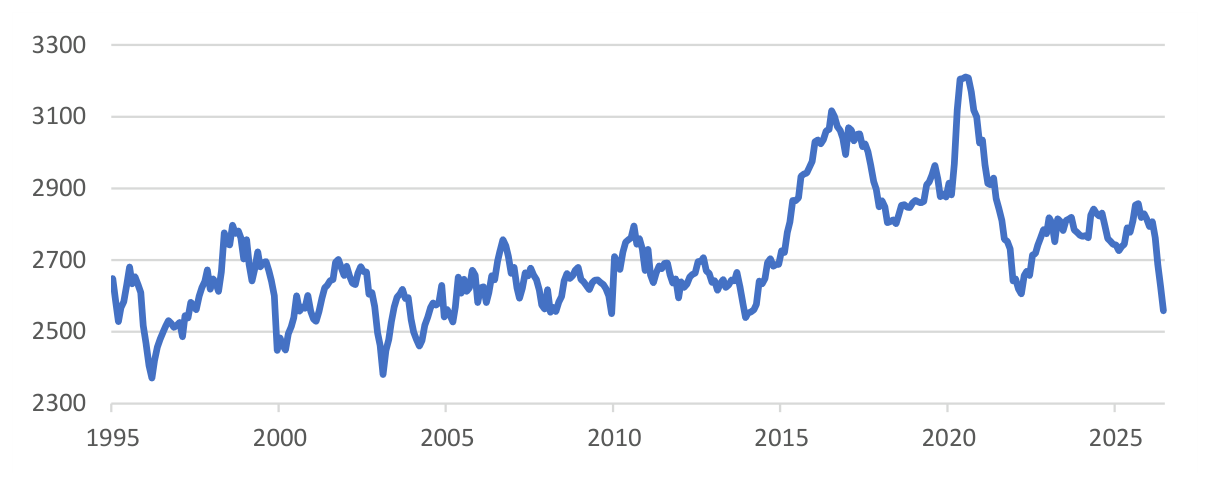
The supply backdrop also deserves closer attention. Across much of the commodity complex, stockpiles remain relatively depleted by historical standards. The market has removed a geopolitical risk premium, but it has not created an abundance of supply. When inventories are high, economic slowdowns can trigger large price declines. When inventories are low, even modest increases in demand can tighten markets rapidly. Stronger global growth, a rebound in Chinese activity or continued AI-related investment could all have a disproportionate impact on commodity prices from current levels.
This is one reason why inflation trend indicators are now approaching an important threshold. They are increasingly close to signalling a transition into what might best be described as an inflationary boom environment – a combination of resilient growth and rising inflation pressures – which have historically favoured commodities, energy producers, precious metals and value-oriented equities, while creating a more challenging backdrop for bonds and growth equities.
We should also see a change in the relationship between oil and gold. During the recent geopolitical turmoil, the two assets diverged. Oil responded primarily to events in the Middle East, while gold struggled in the face of higher bond yields and a stronger dollar. If the broader inflationary-boom thesis is correct, that divergence is unlikely to persist. Oil and gold should increasingly respond to the same underlying macroeconomic forces: stronger nominal growth, rising inflation expectations and renewed investor interest in real assets.
For now, the peace agreement may have removed the geopolitical risk premium from oil prices, but it has not replenished depleted inventories, ended the AI investment boom, or eliminated large fiscal deficits. The peace deal may have changed the headlines, but the underlying story remains remarkably intact.