Article 83
The Active Bets Hidden Inside Passive Investing
Westminster Asset Management Investment Strategist Peter Lucas delves deeper into passive investing. He argues a cap-weighted index is now a large macro bet on the persistence of the low growth, low inflation regime.
For years, investors have been told that the simplest way to avoid the mistakes of active management is to buy the market. Passive investing is cheap, transparent and demonstrably superior to the average stock-picker. All of that is true. What is less often acknowledged is that passive investing is not neutral. A cap-weighted index fund does not simply hold “the market”. It holds a particular version of the market: one that gives the largest weights to the largest companies, adds to recent winners and becomes more concentrated as leadership narrows. In that sense, passive investing has not abolished active management. It has merely hidden it inside the index.
This matters because the choice of index is not an implementation detail. It is a portfolio construction decision. Two investors can both be “passive”, both own the 500 companies in the S&P 500, and still end up with meaningfully different exposures, risks and returns depending on how those 500 stocks are weighted. A cap-weighted S&P 500 fund and an equal-weighted S&P 500 fund hold the same companies, but they do not represent the same investment philosophy.
The distinction is not cosmetic. Equal-weighted versions of the S&P 500 have outperformed the standard cap-weighted index over long periods. In other words, the choice of weighting rule for the same 500 stocks has had a material effect on long-run returns.
The passive revolution has persuaded investors that the key choice is whether to own the market cheaply or to pay an active manager to beat it. That is the wrong question. The more important one is which version of the market they want to own, and in what sort of environment that choice is likely to prosper.
Cap weighting sounds innocuous enough. Each company is held in proportion to its market value. The bigger the company, the bigger its weight in the index. But cap weighting is not the absence of judgement. It is a very particular judgement.
First, it favours size. The larger a company becomes, the more of it you own. Second, it rewards recent winners. When a stock rises faster than the rest of the market, its weight in a cap-weighted index rises automatically. Passive investors own more of it not because they chose to, but because the index rules tell them to. In effect, cap weighting contains a built-in momentum mechanism. Third, it allows concentration to build precisely when markets become most enthusiastic about a narrow set of stocks or sectors. If a handful of mega-cap companies come to dominate the market, the “diversified” index becomes increasingly dependent on them.
The equal-weighted S&P 500 owns the same 500 companies, but gives each the same weight and periodically rebalances back to that position. A cap-weighted index is always adding to success. An equal-weighted index is periodically trimming it. A cap-weighted index allows the largest companies to dominate the portfolio. An equal-weighted index keeps that dominance in check.
That difference has consequences. Equal weighting has more exposure to the smaller members of the index and less exposure to the giants. It also has a value tilt because it systematically adds to stocks that have underperformed and trims those that have become expensive. Put differently, passive investing is not one thing. A cap-weighted index is one set of active choices wrapped inside a low-cost product. An equal-weighted index is another.
If equal weight had merely produced a different pattern of returns, the point would still be worth making. But the long-term record is stronger than that. Equal weighting has historically delivered higher returns than cap weighting over long periods, and the same broad pattern is visible in the chart below. That is awkward for anyone who thinks cap weighting is the natural, neutral way to own equities.
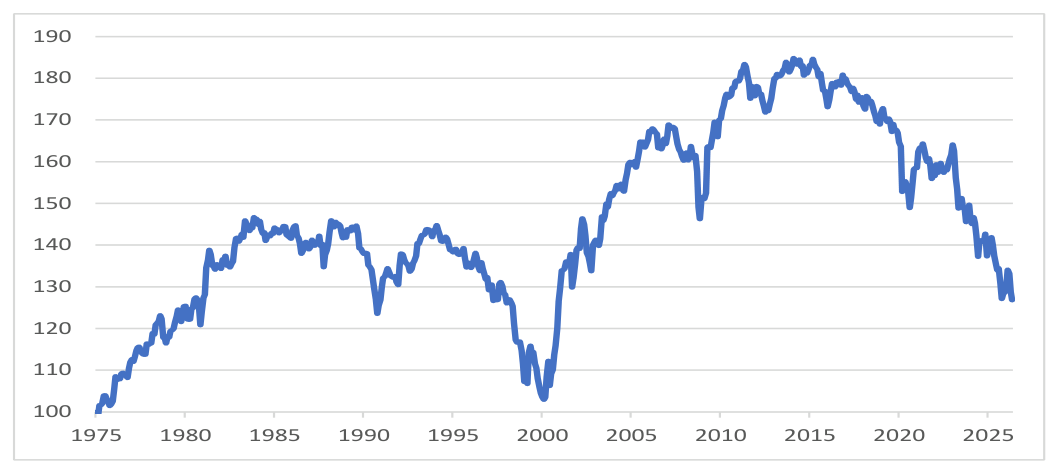
The explanation is not mysterious. Equal weight has outperformed because it systematically did different things from a cap-weighted index. It owned less of the biggest and often most expensive companies, more of the smaller and often cheaper constituents of the index, and it rebalanced regularly. In factor language, it carried more exposure to size and value and less exposure to momentum and concentration.
Neither weighting method is universally superior. Each thrives in different market environments. Cap weighting does best when leadership is narrow and persistent. If the biggest companies keep getting bigger, cap weight benefits mechanically. If momentum is stronger than mean reversion, cap weight benefits again because it is always allocating more to what has already worked. If growth is scarce and investors are willing to pay a premium for the handful of companies capable of delivering it, cap weighting thrives.
Equal weighting excels in almost the opposite environment. It does better when breadth broadens and the average stock begins to participate. It benefits when smaller and cheaper companies catch up with the giants. It works best when mean reversion matters more than momentum, because rebalancing systematically sells some of what has become expensive and buys some of what has become neglected.
The last quarter-century illustrates the point neatly. The 2000s were almost tailor-made for equal weighting. The excesses of the late 1990s unwound, the dot-com bubble burst and the dominance of a narrow group of mega-cap growth stocks faded. Breadth improved, smaller companies and value did better. Mean reversion reasserted itself. Equal weight prospered because the market stopped rewarding concentration and started rewarding breadth. The 2010s and early 2020s were the mirror image. This was an age of disinflation, falling discount rates and a chronic scarcity of growth. A small number of dominant US technology and platform companies were able to compound earnings, expand margins and command ever higher valuations. The biggest companies did not merely remain large; they became larger still. Momentum persisted. Market leadership narrowed. The winners kept winning. This was an almost ideal environment for cap weighting. Its extraordinary success was not proof of neutrality. It was the product of a regime in which the largest, fastest growing and most highly rated companies kept justifying ever larger weights.
There is, however, an important nuance. Equal weight is not simply a value strategy, and cap weight is not simply a growth strategy. A broad reflationary value rally - the sort that lifts banks, industrials, energy, materials and the smaller constituents of the index - is usually good for equal weight. An inflationary bust - a period of slowing growth combined with sticky inflation - can be different. In that environment, smaller and more leveraged companies may come under acute pressure from higher rates, tighter credit and weak demand, while investors retreat into a narrower group of large, cash-generative businesses. That can create the conditions for cap weighting to hold up better than equal weighting. But it is not enough on its own. For cap weight to outperform, the valuation of the market leaders must also be reasonable. If the cap-weighted index enters the downturn dominated by a handful of stocks priced for perfection, the de-rating of those leaders can still overwhelm the relative weakness of the rest of the market.
That matters because today’s market is not entering this debate from a position of neutral valuations. It is entering it with concentration near multi-decade highs and a large valuation premium embedded in the index leaders. The ten largest constituents of the S&P 500 now account for roughly 39% of the index, a level of concentration not seen since the mid-1960s. A cap-weighted US index is therefore much more than a broad claim on corporate America. It is a large bet that the conditions of the 2010s persist: narrow leadership, strong momentum, continued dominance by mega-cap growth and a willingness by investors to keep paying up for it.
My own view is that this is the wrong regime to extrapolate. The more likely path is an inflationary boom: stronger nominal growth, firmer pricing power and broader earnings participation across the market. If that is right, the scarcity premium attached to a narrow group of mega-cap leaders should erode, breadth should improve and today’s extreme concentration and valuation gaps should favour equal weighting over cap weighting. More companies would be able to grow, more sectors would participate and the market would no longer need to rely so heavily on a handful of dominant stocks to generate index-level returns. In that sense, a cap-weighted index is not just a passive vehicle. It is an explicit bet against a broadening of nominal growth.
The point of this argument is not that investors should abandon passive funds or mechanically switch from cap weighting to equal weighting. That would merely replace one dogma with another. The real lesson is more fundamental. Investors should stop confusing low-cost implementation with neutrality. There is no such thing as passive in portfolio construction. There are only rules, and those rules embody choices. Cap weighting is one set of choices. Equal weighting is another. The question is no longer whether investors should be passive or active. It is whether they understand the active bets they are already making.