Article 75
Inflation, discipline and where to hide
Westminster Asset Management Investment Strategist Peter Lucas takes another look at inflation, a long running theme. Peter considers prior periods of rapidly rising prices, and how a country addresses this issue can have significant implications for local asset prices. He believes that many parts of Asia are well positioned to deal with this potential problem.
High - and more particularly accelerating - inflation is arguably the greatest threat to financial assets.
Bonds are the obvious casualty. Fixed coupons provide no protection against a rising price level; real returns are eroded as inflation accelerates. Equities are often described as an inflation hedge. In theory, companies can pass on higher costs. In practice, history is less forgiving.
Over the long run, equities have delivered real returns of roughly 6-7% per annum. But the bulk of that performance has been generated during periods when inflation fell or was below roughly 4%. When inflation accelerates, valuation multiples compress and real returns deteriorate. The real danger is not high inflation per se. It is accelerating inflation.
For now, inflation appears contained in most developed economies. That is reassuring - but potentially deceptive. Structural fiscal deficits remain large. Commodity prices are firm. Central banks are cutting rates despite inflation still running above target in several jurisdictions. If policymakers attempt to suppress borrowing costs to shield over-leveraged governments, inflationary pressures may re-emerge rather than subside.
We saw in 2022 how abruptly markets can reprice when inflation accelerates - particularly when asset valuations are rich by historical standards. When a country as large as the United States gets into macroeconomic difficulty, it is tempting to conclude that markets everywhere will struggle. Yet the 1970s tell a more nuanced story. During that decade, inflation surged as the US pursued its “guns and butter” mix of fiscal expansion and accommodative monetary policy. The dollar weakened following the collapse of Bretton Woods. Real returns from US bonds were deeply negative, and equities struggled to preserve purchasing power.
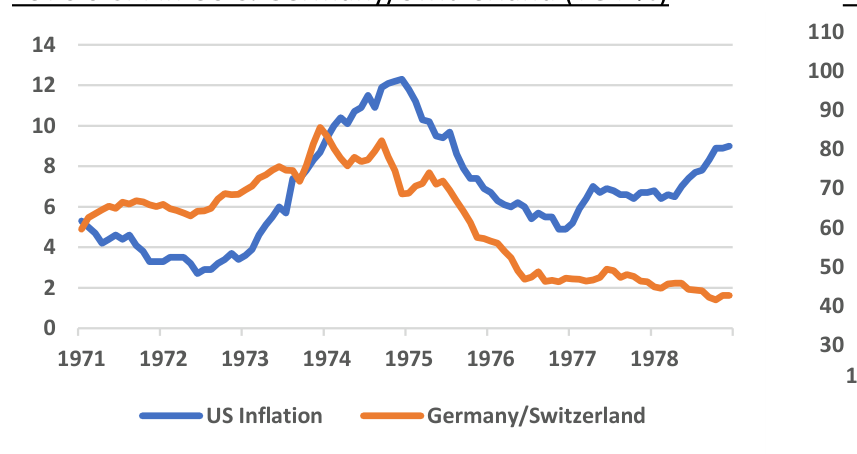
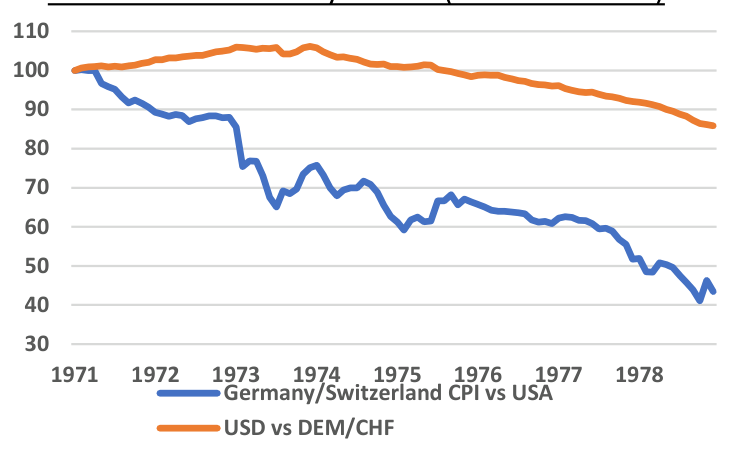
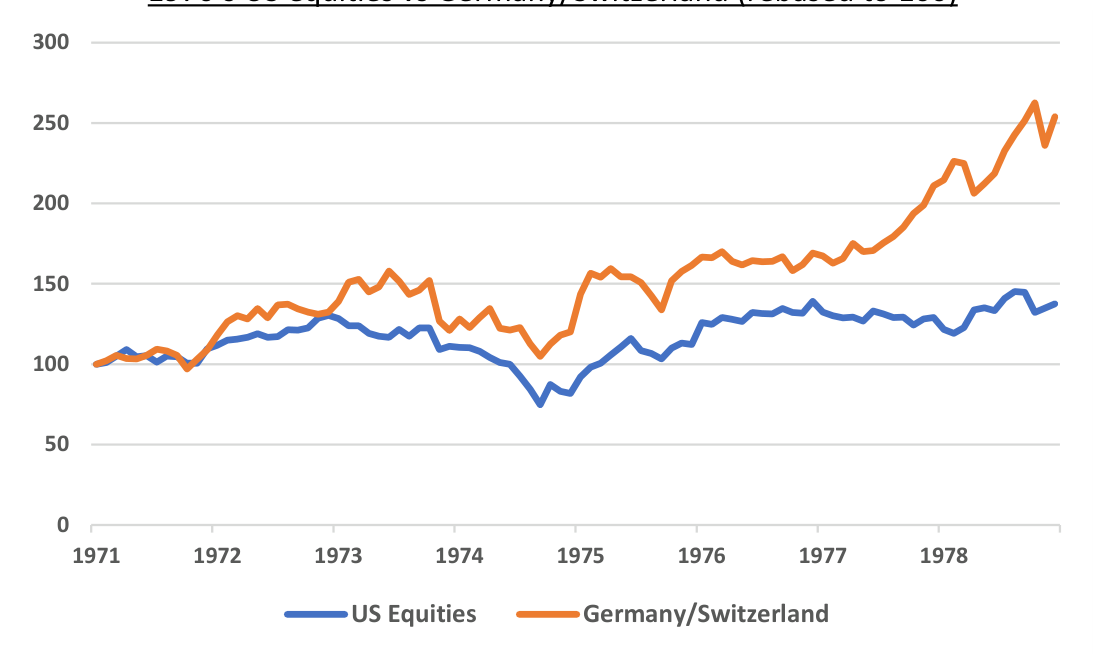
Meanwhile, Germany and Switzerland chose a more disciplined path. They prioritised price stability. Fiscal policy was comparatively restrained. Capital flowed toward their currencies, which strengthened and helped insulate their economies from imported inflation.
The result was striking. Inflation remained materially lower than in the United States. Bonds preserved far more real value. Equity markets significantly outperformed their US counterparts in common currency terms. Policy credibility mattered. Currency strength mattered. Discipline was rewarded.
Half a century later, the European parallel is less compelling. Switzerland retains its reputation for orthodoxy, but the Swiss franc is no longer the undervalued currency it was in the early 1970s. Germany meanwhile operates within the euro system. Monetary policy is set by the European Central Bank, whose responsibilities extend beyond pure inflation control to preserving cohesion across a diverse currency bloc. If there is a modern analogue to 1970s Germany and Switzerland, it may lie in parts of Asia. Across much of the region one finds:
• Currencies that are cheap in real effective terms • Lower sovereign debt burdens than in the US and parts of Europe • Stronger external balances • Higher domestic savings • Continued regional commitment to trade integration
These are not guarantees of outperformance. But they are good starting conditions in a world where fiscal excess and debt sustainability are becoming central themes. It is notable, for example, that the Chinese renminbi has appreciated by roughly 5-6% against the US dollar since last spring - a meaningful move for a carefully managed currency.
Equity markets across parts of Asia are not cheap relative to their own histories, but they are reasonably priced by international standards - particularly when compared to US multiples. If inflation were to re-accelerate and capital begins to discriminate more aggressively between fiscal regimes, regions combining currency stability with lower leverage could benefit from re-rating.
The next inflation cycle, when it comes, will not treat all markets equally. It never does. In the 1970s, disciplined economies with strong currencies and lower inflation quietly outperformed a fiscally stretched superpower. Today, parts of Asia appear better positioned than most to play that role. For investors, the question is not whether America faces challenges - but whether capital once again migrates toward discipline.