Article 72
The calm before the storm
Westminster Asset Management Investment Strategist Peter Lucas has a look at global markets and the likely direction we are headed. Peter finds that fund managers are the most overweight in years and simultaneously the most worried about bubbles. Central banks are cutting rates into above-target inflation. Currencies are unnaturally quiet. Here’s what he believes that combination really means.
Bit by bit, the world’s major economies are edging into dangerous territory. France sits on a powder keg of public and private debt. America has a government that shows little interest in economic orthodoxy. And in Britain, the lesson of David Cameron’s failed austerity experiment has been misunderstood - at least he cut spending; today’s policymakers want to close the deficit almost entirely through higher taxes.
Churchill supposedly warned that “for a nation to try to tax itself into prosperity is like a man standing in a bucket trying to lift himself up by the handle.” He would not be impressed.
The uncomfortable truth is that the money is running out, voters are restless, and political leaders look unable or unwilling to take the difficult decisions needed to steer away from worst case scenarios. In short: the countdown to a debt crisis has begun.
You would not know it from looking at markets. Bond yields and oil prices have drifted sideways for two years, and global equity indices remain close to all-time highs, even on an equal-weighted basis.
But the contrast between precarious fundamentals and calm markets is not as crazy as it looks. Growth and inflation have been remarkably stable - classic "Goldilocks" conditions. Large-cap growth stocks thrive in this environment, which is why so many valuation-focused bears keep getting their fingers burnt. These stocks will eventually come back to earth, possibly with a bump, but not simply because they are expensive. They will fall when the fundamentals change, not before.
Central banks have not helped the longer-term picture. Rate cuts have arrived despite above-target inflation and little evidence of recession. With already tarnished reputations, they are playing with fire: if inflation bottoms and turns up again, credibility will be shattered for the second time this decade. History is clear: 3-4%+ inflation is a danger zone for equities, and virtually all real US equity returns have been earned when inflation was below that level.
Higher inflation from here would be toxic for both bonds and equities, but positive for real assets, especially commodities.
So where does that leave the short-term outlook? The latest Bank of America Fund Manager Survey reveals a market on edge: managers are heavily overweight large-cap growth, yet also believe these stocks are in a bubble. Cash levels are low (greed), but the put/call ratio is elevated (fear). Many indicators are pointing in different directions, which is not helpful from a contrarian perspective.
The economic backdrop remains supportive for now. Growth is stable - Atlanta Fed GDPNow has been in the 2-4% range since May - and inflation is trending lower, though starting to show signs of bottoming. That keeps the bull case alive, but only just.
What tips the balance is the bubble narrative. Markets rarely peak when everyone is waiting for a crash. True bubbles burst when speculation is euphoric, not when investors keep looking nervously over their shoulder. Historically, bubble tops tend to follow periods of monetary tightening and rising yields - neither of which we have today.
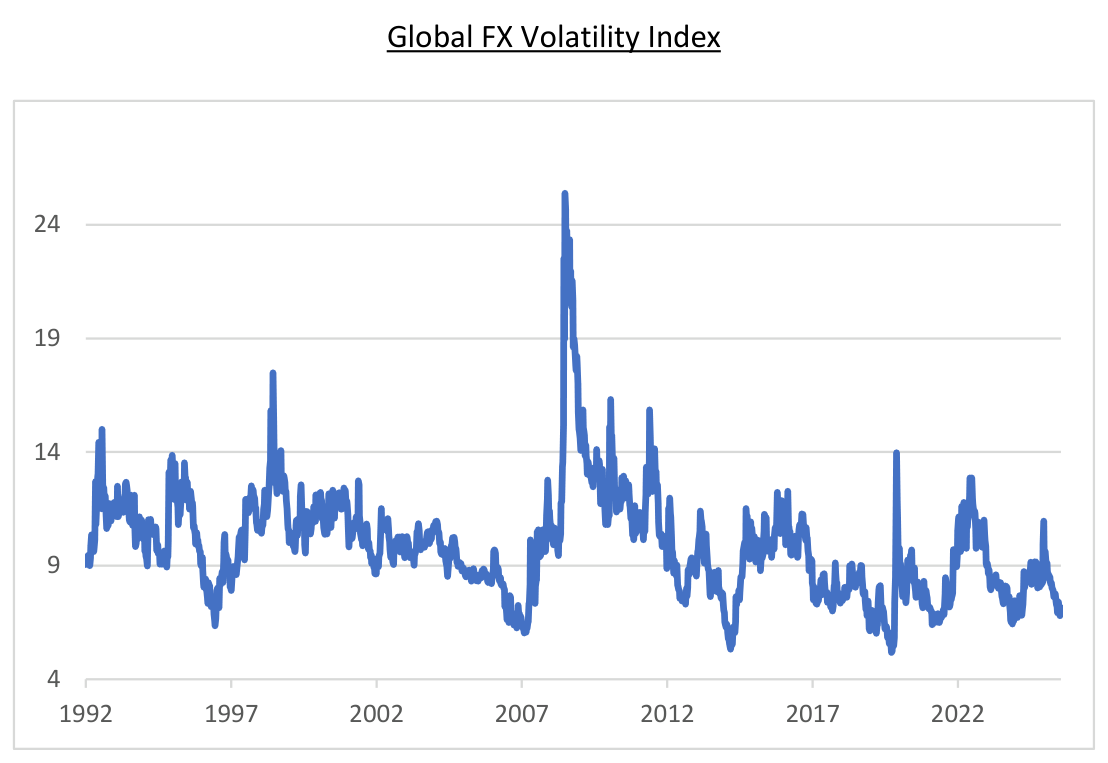
The real catalyst could come from currencies. FX volatility is close to historic lows. No major region wants to run the world’s strongest currency - Asia is doing it reluctantly, and the West simply cannot afford to. A decisive FX move (Asia up, or a Western currency down) would force others to respond. Weaker currencies will import inflation; stronger currencies will be met with aggressive easing. Either way, the long-term story is clear: most developed-world currencies will devalue against real assets.
For now, we are living through the calm before the storm. The data is stable, the markets are serene, but the structural pressures are intensifying beneath the surface.
The next move - when it comes - will be fast.