Article 69
Asia – the new global leader
Westminster Asset Management Investment Strategist Peter Lucas continues his examination of the changing world order with reference to the political crisis in Europe, America’s fading exceptionalism, and Asia’s quiet financial revolution. He argues that what once kept Western inflation and interest rates low is now working in reverse - and the consequences will be profound.
My core view remains that any improvement in the relative performance of European equities will be short-lived and that US equities still represent the “least dirty shirt,” at least within the developed West (see Turning the Screws on Europe, February 2025 and Chickens Come Home to Roost, August 2025). But that does not mean Wall Street’s dominance will remain unchallenged.
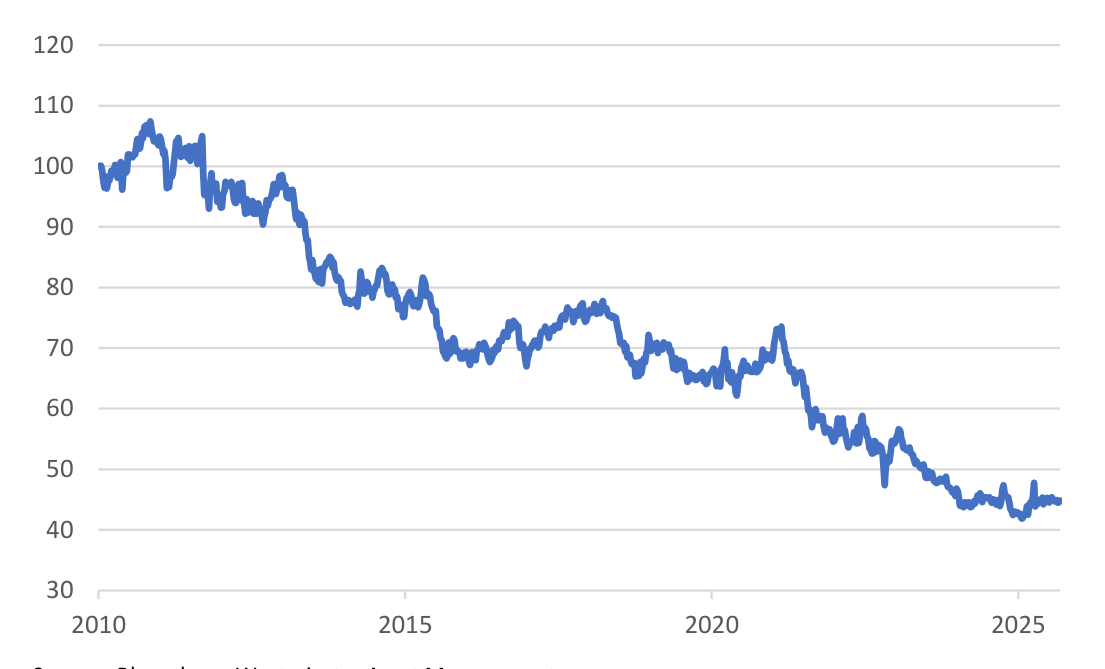
For years, hopes for an “Asian century” proved disappointing. Since 2010, Asia has even underperformed heavily regulated Europe. But conditions are shifting. The scars of the 1997 crisis—when currencies collapsed, international capital fled, and IMF-imposed austerity compounded the pain—left a lasting imprint. Asia’s answer was “never again”: hold currencies down to protect exports, build up vast US dollar reserves, and insulate economies from capital flight.
That playbook is now being discarded. America’s weaponisation of the dollar—freezing Russia’s reserves and cutting it off from SWIFT—was a shock to policymakers across the region. If Washington could do this to Russia, why not China or others?
The response has been dramatic:
- A shift in reserves away from Treasuries and into gold.
- More commodity trade, notably oil, settled in local currencies.
- A greater willingness to let Asian currencies rise, rather than hoard dollars.
This reversal is profound. For decades, undervalued Asian currencies and recycled capital kept Western inflation and borrowing costs low, while suppressing wages in the US and consumption in Asia. Today, these roles are flipping – inflation and yields are climbing in the West but falling in the East. Chinese government bond yields now sit more than 200bps below Treasuries. Asian consumers, armed with stronger currencies, are gaining spending power.
What we are seeing is the early stage of a global rebalancing. In theory, this is positive: more balanced growth, stronger Asian demand, and less dependence on US deficits. In practice, the transition will be messy. Western economies, weighed down by high debts and inflated asset prices, will struggle with structurally higher borrowing costs. The irony is that policymakers in Europe and America remain fixated on “solving” the problems created by the old order—like high housing costs—just as that order collapses. Their interventions are likely to backfire, making the adjustment harsher.
Asia, by contrast, is better placed. Spurned by the US, China is reorienting toward its neighbours and the BRICs, deepening trade ties that play to comparative advantage. Stronger currencies will insulate the region from the next inflation wave, much as the franc and deutschemark shielded Switzerland and Germany in the 1970s. Lower debt burdens mean higher rates, if they come, will be manageable.
Asian equities and currencies have already outperformed in 2025. That looks less like a blip and more like the beginning of a larger trend.