Article 66
The next inflation wave
Westminster Asset Management Investment Strategist Peter Lucas has another look at inflation, a subject of critical importance to all investors and borrowers. Peter believes higher inflation is all but inevitable as indebted governments across the developed world face painful fiscal choices.
I have long believed that inflation would be the end game of the present government debt bubble, mainly because the alternatives were either unpalatable or impractical. Governments would not be able balance their books by increasing taxes (austerity) because
- as David Cameron found and Kier Starmer is now discovering – it is a self-defeating process; higher taxes kill the economy, leading to lower tax revenues and bigger government outlays. Governments are unlikely to outright default because that would unleash debt deflation, which – as we saw in 2008 – can be a scary, destructive and indiscriminate force. Obviously, growing your way out of a debt problem is the most desirable outcome – and much hope rests with AI in that regard – but the wave of creative destruction that it is unleashing could mean that things get worse before they get better, and we may not have the luxury of time.
Inflation is effectively default by the backdoor; governments continue to repay their debts, but with money that is worth less than when it was first borrowed. Inflation is both insidious and (to a point) fair – the pain is inflicted gradually over time and across the whole economy. It is no wonder that inflation has been the favoured method of default of monarchs and governments through history. But how do we get to accelerating inflation and what must investors do to protect themselves against it?
Although higher inflation is probably all but inevitable, the path by which we get there is not clear. However, it is not too hard to see how it might come about. Central Banks know that insufficient growth could cause debt levels to grow, as tax revenues fail to keep up with spiralling interest costs (much like austerity, see above). Equally, too much growth could lead to higher inflation and rates. And as debt piles get bigger, the tightrope that they are walking is getting narrower and narrower. Furthermore, they must work with politicians that are becoming increasingly cavalier about fiscal policy. Although inflation has generally fallen in the past couple of years, bond yields have remained elevated due to rising political and economic uncertainty.
Meanwhile, there are three conflicts in Europe and the Middle East, any one of which could go global, leading to all sorts of supply chain issues. How would central banks respond to, for instance, a much higher oil price? Would their priority be growth or inflation? Given the harsh realities or managing the debt problem (see prior paragraph), they will surely protect the former at the expense of the latter. But that could destabilize inflation expectations (which are already jittery). Indeed, any attempt to cap bond yields – keeping interest rates low, quantitative easing and/or capital controls – would tend to push inflation higher, and by extension bond yields and interest rates. Another self-defeating process.
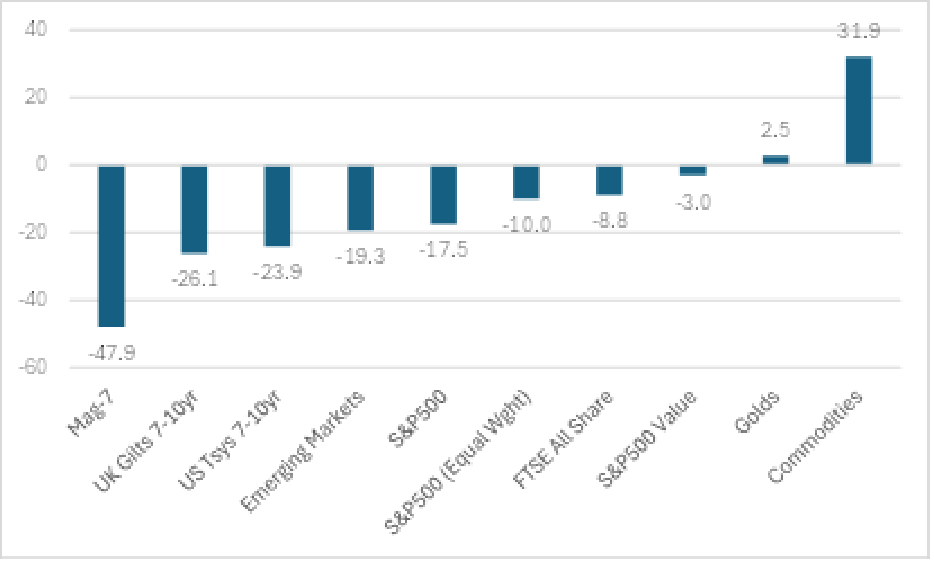
Let us presume that higher inflation is coming – how can investors protect themselves? Government fixed income bonds are obviously something to be avoided. They offer no inflation protection and are at the heart of the global debt problem. Commodities might be bad buy-and-hold investments in the long run, but in the short run can perform very strongly in the event of rising inflation (and of course, rising commodities help to feed the inflation problem). Equities are a mixed bag. Highly valued growth stocks are most at risk given the tendency for valuations to come under pressure when inflation accelerates. In contrast, value stocks are already cheap and should hold their own, particularly given that their ranks include the likes of oil companies and mining shares, which benefit directly from rising commodity prices. Emerging markets should also be a good place to be, given the exposure that it bestows to Asia and commodity-producing countries. But do not just take my word for it, just look at the chart above which shows the winners and losers in 2022, the year that inflation was proved not to be transitory. I see this as a blueprint – emerging markets aside – for what is to come.
Of course, I could be wrong. But given that many, if not most portfolios are stuffed with potentially all the wrong things, I urge investors to ask their investment managers two important questions: (1) if inflation were to return, what flexibility do you have to protect the real value of my portfolio? and (2) how willing are you to use that flexibility? If I’m right, putting 5% in gold is just not going to cut it.