Article 64
Taking stock
Westminster Asset Management Investment Strategist Peter Lucas considers recent moves in the government bond and currency markets. Peter believes we are seeing early signs that major change is approaching.
My last update on the ‘countdown to crisis’ was three years ago (“Updating the big picture,” April 2022). In that note I restated my central thesis that we were heading inexorably into a government bond blow up, courtesy of the following:
Income inequality and the consequential rise of populism and bifurcation of politics. • Bad policy making – deglobalization, government activism, geopolitical instability, and big deficits – leading • to structurally higher inflation. Worries about the extent of government borrowing and rising bond yields (which make the debt even less • affordable). High market valuations that do not sit comfortably with higher/rising inflation. •
In other related articles, I also shared my expectation that there would be (a) steps taken to cap government bond yields (financial repression, quantitative easing, and may be even capital controls), and (b) a general revaluation of Asian currencies. Both these developments would reinforce the coming inflation story.
The political fallout from income inequality and stagnating real incomes has been evident for a decade. Voters have deserted the middle ground in search of different ideas and solutions. The last election came too soon for Reform and Labour won largely because they were not the Tory party. Since then, voters have abandoned Labour as they have come to realise that they are just more of the same, or worse. A similar thing has happened with Macron in France.
Predictably, the quality of policy making has deteriorated, with discredited ideas like protectionism, regulation, and nationalization making a comeback. Thus far, this has not translated into higher inflation. In fact, inflation has fallen as growth conditions have cooled, and supply bottlenecks have eased. However, despite a halving of the oil price, it has not managed to get back down to the pre-COVID range, with 2% now looking more like a floor than a ceiling.
Bonds have failed to benefit from the drop in inflation, with yields tracking sideways for the past year and a half, resulting in a significant rise in real yields. This is due to a combination of supply worries and rising economic and market volatility. The authorities have not yet felt the need to intercede, but I sense that such a moment is just around the corner (Japan is already thought to be considering measures to flatten the curve). But to repeat, any such intervention should be self-defeating and bond recoveries will therefore prove to be temporary in nature.
Most commentators have been confidently predicting a weaker Chinese currency and by extension, a general weakening in Asian currencies. I have held the opposite view for the following reasons:
• Asian currencies are already cheap and backed by current account surpluses. • Although China has its problems, it is far from clear that they exceed those of Western economies. Furthermore, China has scope for catch-up growth in agriculture and in its domestic consumer market. • Efforts to isolate the Chinese economy will fail and are a form of self-harm. • Devaluation would run counter to China’s plans to foster confidence in the yuan as a store of value and as an international reserve currency.
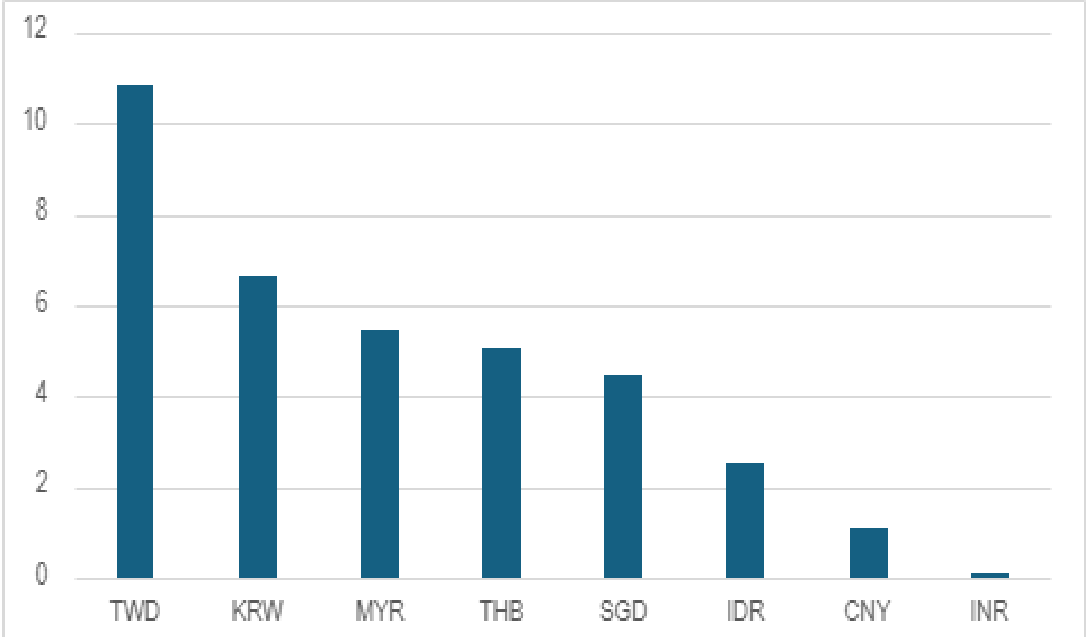
Earlier this month (“An important piece of the jigsaw”, May 2025) I highlighted the fact that Asian currencies had started to appreciate. The biggest mover has been the Taiwan dollar, which has strengthened 11% versus the US dollar, thereby unwinding over two years of weakness in just six weeks. At this early stage, there are more questions than answers. Does this represent a major change of FX policy in Asia? What is its purpose: to appease Donald Trump or to give the Asian consumer something of value to spend. I suspect that the answer is yes in all cases, and that yet another key part of the inflation story is falling into place.
In summary, the big picture continues to evolve in line with expectations. Inflation is currently low and stable but that will not last, particularly given the fiscal easing coming in China, Europe and America.
As far as markets are concerned, back in 2020 I highlighted commodities, value shares, and inflation-linked bonds as three assets to own in a rising inflation environment; more recently I have added emerging markets to that list. The first three performed well as inflation took off in 2021-2 but have since corrected, in absolute and/or relative terms. The one major exception has been gold, which has remained strong throughout, propelled by central bank buying and latterly, renewed interest from retail investors. Indeed, gold has been one of the best performing investments of the past three years.
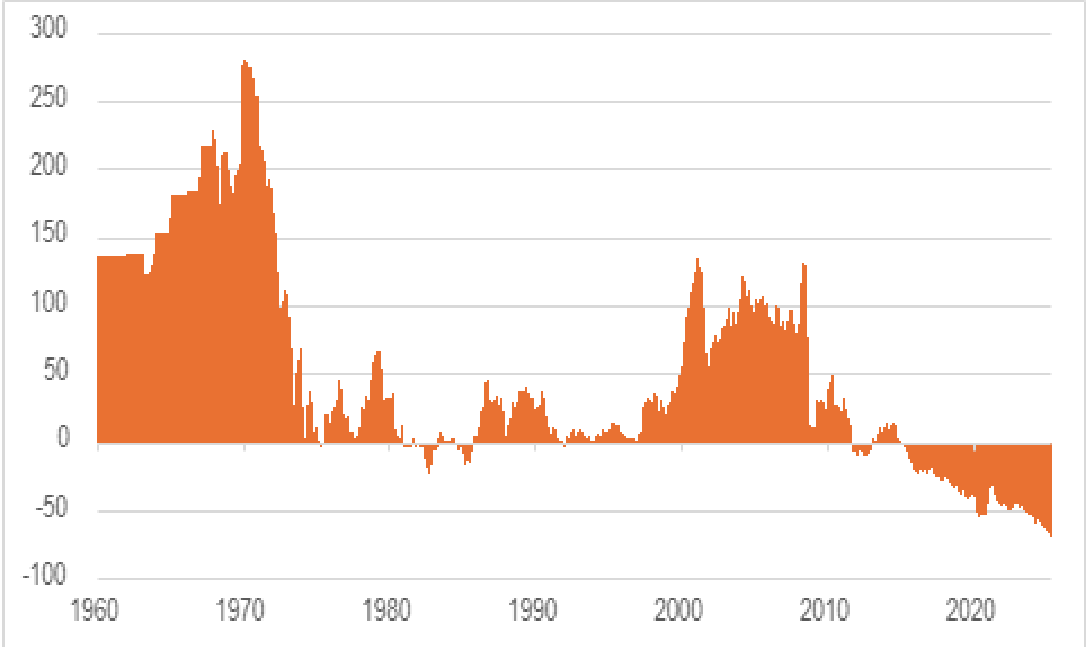
Gold has a habit of leading the broader commodity complex at major turning points. In that regard, gold’s recent outperformance is typical, if more pronounced than we would normally expect. Indeed, this outperformance has left gold looking expensive relative to many other commodities, leaving substantial room for mean reversion. An extreme example in that regard is platinum. Somewhat rarer than gold, the platinum price has often traded at a premium to gold but is currently 70% below. There have recently been reports that its low price is motivating Chinese jewellers to use platinum rather than gold. Furthermore, having moved sideways for four years, the platinum price is finally showing signs of life, on both an absolute and relative basis. Early signs perhaps that the commodity story is starting to spread beyond gold.
Equities took a beating when Trump unveiled his tariff plans on “Liberation Day” but have since recovered nicely as Trump’s position has softened and investors have refocused on what remains a supportive environment of low growth and low/stable inflation (as predicted in “The most beautiful word in the dictionary,” April 2025).
Unsurprisingly, growth shares are outperforming again, but investors should not overstay their welcome given the darkening outlook for inflation. Asian currency strength and the breakout by platinum could be the first early signs that a major environment change is at hand. Look for confirmation from an upside breakout by government bond yields.