Article 62
The most beautiful word in the dictionary
Westminster Asset Management Investment Strategist Peter Lucas considers the tumultuous beginning to April that markets are experiencing. While there is certainly much to fret over, Peter also believes markets are overlooking potential positives.
On April 2nd (“Liberation Day”) the President revealed his trade policy to an unsuspecting world. Tariffs were to be raised more than expected and stock markets plunged. Perhaps even worse, he failed to say what countries need to do to be excluded from his crusade to put “America First”. In the face of very negative investor sentiment, the S&P 500 dropped 10.7%, the eleventh biggest 3-day fall since WW2. With markets now recovering, this seems a good time to take stock.
Although a free marketeer by instinct, Trump has long been a fan of tariffs, seeing them as a means by which he could iron out the perceived injustices in America’s trading relationships.
Before Liberation Day, there were good reasons to be relaxed about the outlook for stocks. Growth conditions were reasonable; Europe was talking about increased spending on infrastructure and/or defense; inflation was low and stable, albeit above target in some cases; interest rates were stable or falling; and the oil price was bang in the middle of its narrow 3-year range. Furthermore, what little bad news there was looked well discounted, with some sentiment measures close to multi-year lows.
Higher tariffs are like a tax on consumers; they push up inflation making it less likely that central banks will reduce interest rates; and they complicate supply chains, particularly for firms whose parts cross borders several times during the construction process. Given all this, the negative response of markets was understandable.
Interestingly, government bonds have failed to rally despite the downturn in equity markets and growing calls for a US recession. Five years ago, this same combination saw yields plunge towards zero; this time, the usual flight-to-safety trade quickly ran out of steam, and yields were soon back above levels seen just before Liberation Day. There was talk of selling by China, but whatever the cause, government bonds are clearly not as ‘safe’ as they used to be. This is to be expected when ‘government’ is essentially the heart of the problem, whether we are talking about debt levels or policy uncertainty.
On 9th April, Trump announced that tariffs would be raised to only 10% across the board, with bigger increases deferred for 90 days (China excepted). With sentiment on the floor, markets responded positively, with the NASDAQ100 registering its third biggest rise since 1990. Did Trump blink? Or was this the plan all along? With dozens of countries now queuing up to do a deal, no doubt Trump will chalk this up as a win, and with a decision deferred for three months, markets will lick their wounds and recuperate.
The huge increase in tariffs on US-China trade will complicate things massively on both sides. China’s trade surplus with America might lead one to conclude that it has more to lose from this trade war, but it may not be that simple. There is much that China can source from elsewhere (particularly commodities), but it is less clear that this is the case for America. Indeed, this will be very disruptive for US manufacturing, with some economists saying that a recession will be the inevitable result. None of that is showing up in our US economic models, but that may just be a question of time. On a more positive note: (1) manufacturing is a small part of the US economy, plus the lower oil price will help to cushion the blow, particularly if it persuades central banks to cut interest rates, (2) firms may be able to reroute transactions through countries subject to lower tariffs and (3) many countries (and China in particular) introduce measures to support economic growth.
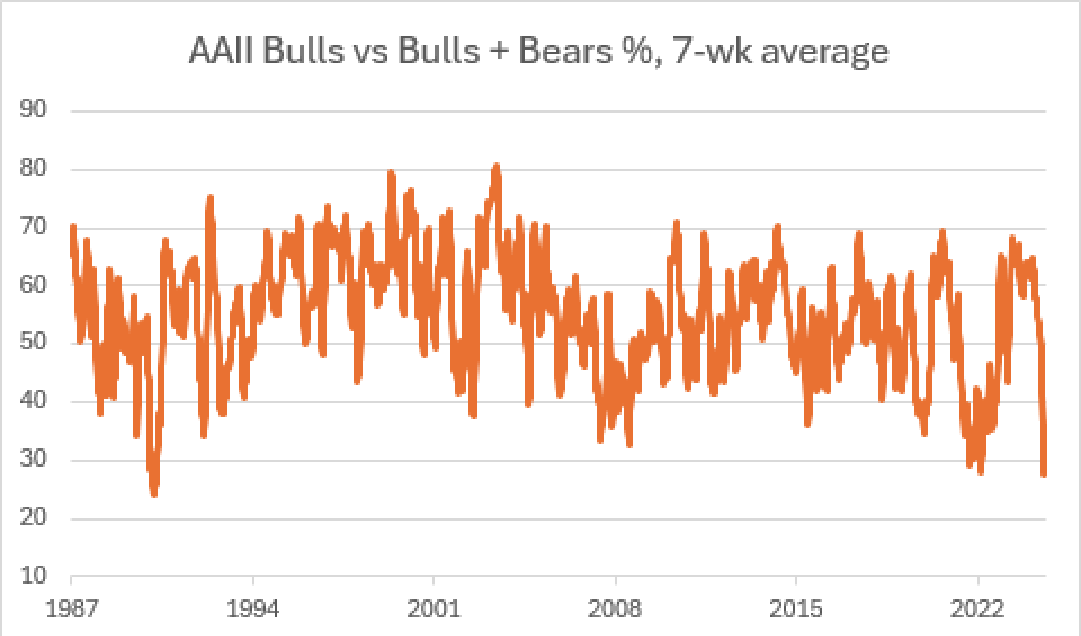
Some contrarian indicators have been sitting in buy territory for a month or more. It is unusual for them to remain that depressed for so long. Take for instance the American Association of Individual Investors weekly survey, which has been below 30% (a reliable buy threshold) for five of the last seven weeks, with a seven-week average of 27%. Since 1987 there have only been two occasions when that level has been matched or broken: October 1990 and October 2022. Both proved to be major turning points in the stock market.
In summary, the worst-case scenario has been taken off the table for now and it is possible that some countries will successfully negotiate new trade deals with America. Given the damage being inflicted on its trading relationship with China, it is possible that the US economy might slip into a technical recession, but given the pessimism prevailing around the low, one suspects that much of that is already discounted. In the absence of more bad news, equity markets should stage a decent recovery in the weeks ahead.