Article 60
Turning the screws on Europe
European equities have broken out and are outperforming for the first time in a while. But Westminster Asset Management Investment Strategist Peter Lucas believes Trump’s America-First agenda is going to make life for Europe even harder than it has been. Europe is not yet ready to reverse its longer-term trend of relative decline.
Following the launch of the euro in 1999, the new Eurozone region enjoyed almost a decade of uninterrupted good news. Unemployment fell, narrowing the gap with America; economic growth was reasonable, if not spectacular; and its equity markets outperformed, albeit that was more down to the strong euro than anything else. Unfortunately, the good times were not to last. The significant convergence of bond yields throughout the Eurozone, sparked by the introduction of the euro, led to inflationary booms in the periphery, rendering them uncompetitive. Boom then turned to bust as the ECB tightened the screws in response to rampant commodity price inflation, culminating in the Eurozone debt crisis. Much as Central Banks had backstopped the economy during the financial crisis, the ECB pledged to do “whatever it takes” to rescue the euro. The plan worked but at what cost? Negative interest rates did massive harm to the banks and the pensions industry and thwarted the beneficial process of creative destruction. In effect, the eurozone economy was put on life support.
Since 2008 the news has been depressingly bad. Even if we exclude the financial crisis, real economic growth has been one percent per annum lower than in the previous decade; unemployment has fallen marginally, but the gap with America remains; and its stock markets are barely higher today than they were in 2007 and have underperformed Wall Street by a massive margin (although, to be fair, they are not alone in that). To this list of woes, you can now add political instability caused by stagnating living standards, widening inequality and uncontrolled immigration. The optimism of 1999 almost seems laughable now.
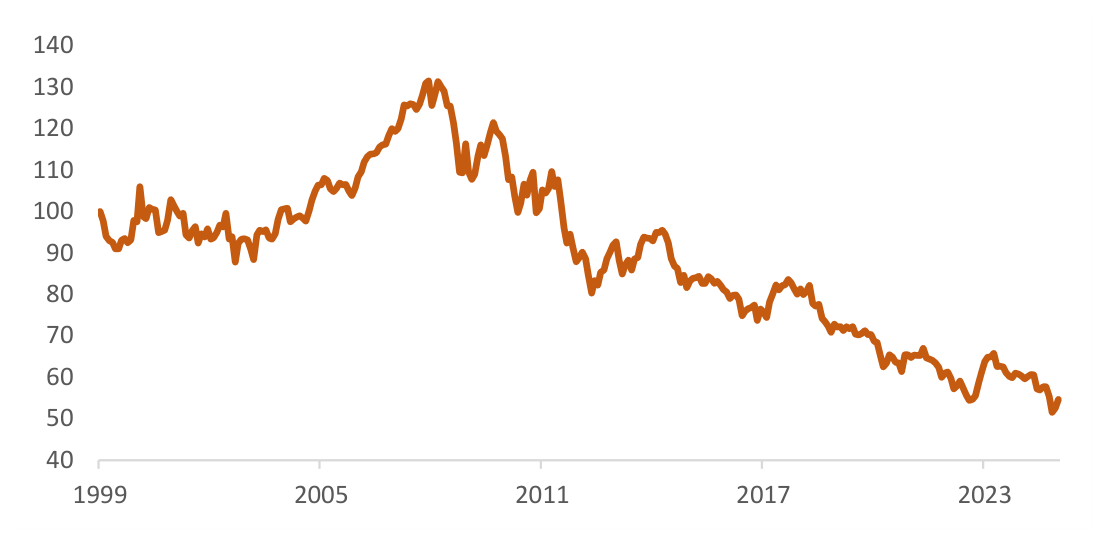
Chart 1: Equities Total Return - Eurozone markets versus the World Index (Source: Bloomberg)
Trump 2.0 is now busily abandoning many of the things that Europe holds dear: membership of supranational bodies, commitment to the Paris Accord, and DEI initiatives. In addition, he has said that (a) America should step back from its role of global policeman and that other countries (most notably in Europe) must fund their own defense needs (b) there will be a forensic review of the public sector, with a view to cutting unnecessary spending and increasing efficiency and (d) he will cut corporation tax. All this, plus a willingness to use tariffs to get his way. America is now very much at odds with Europe.
In time, Europe will find itself having to compete with a more vibrant and competitive America. Will this be the catalyst for change in Europe? Alas, that seems very unlikely. If so, the relative decline of Europe will enter a new pernicious phase, leading to even more political instability. How long will it be before a euro-sceptic government is elected, leading to another existential crisis? And in an environment of shaky inflationary expectations and elevated debt levels, can the ECB rescue the euro a second time?
Having been widely shunned at the end of 2024, European equity markets have recently outperformed. Furthermore, many indices have broken out of the ranges that have contained them for eight months or more. Every dog has its day. Many are concerned about the expensive dollar and the high level of valuations on Wall Street, but until Europe embraces reform or (more likely) is forced to do so by another crisis, it is hard to see US assets underperforming for long.