Article 61
No Pain, No Gain
Westminster Asset Management Investment Strategist Peter Lucas continues his recent focus on the Old Continent where governments seem to be doubling down on the same policies that have led Europe to where it is today, in sharp contrast to policies coming out of the US.
Trump has recognized that America is on an unsustainable path and has embraced economic reform. Meanwhile, Europe is also changing its ways, but not necessarily for the better.
Most Western economies have masses of debt and significant unfunded liabilities (social security, pensions, and healthcare, all courtesy of unhelpful demographics). It has been clear for some time that action would be needed if calamity was to be avoided. Thus far, politicians have largely ducked the issue, mainly because it is a thankless task. But Trump is not your regular politician – he is barely a Republican – and he has decided that the time to act is now. In his first term he talked a lot about reform but relatively little was achieved. This time he is much better prepared, with a united team and a clear plan of action.
Under Elon Musk, the new Department of Government Efficiency (DOGE) has set about doing to the public sector what he did to Twitter, now X. There is a long way to go, but he has got off to an impressive start. However, we must not lose sight of the fact that reform like this is painful – people are being laid off and the umbilical cord of public money is being constricted – which probably means that the immediate prognosis for the economy – particularly around Washington DC – is not that great. It is not showing up in our growth indicator yet, but it is surely coming. In keeping with that, the bond market has stabilized and looks like it wants to recover. Conversely, the US dollar and US stocks are both turning over. Eventually, these painful reforms will bear fruit – most notably in the form of tax cuts – but that will take time.
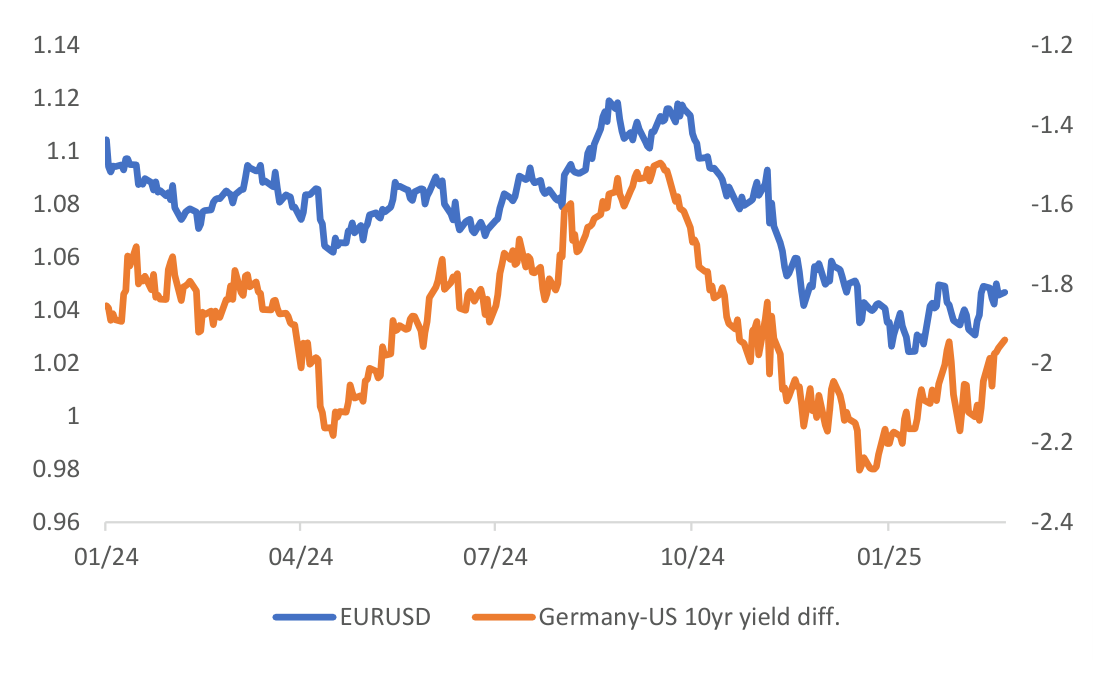
Chart 1: EURUSD vs 10 year yield gap (Source: Bloomberg, Westminster Asset Management)
Meanwhile, Europe has no such thoughts about saving money. Quite the opposite. As America steps back from protecting the Old Continent, the talk in Europe is about increasing defence spending – as reflected in the impressive performance of defence stocks. As good as that might be for growth prospects in the region, buying more bombs and fighters is not like building bridges and airports – there is less economic payback and may well prove to be inflationary at the margin. Little surprise therefore that European bonds are looking rather less assured than they did just a few weeks ago and the euro has managed to pull out of its 5-month decline. Most impressive of all, European equities have broken out of 12-month holding pattern and in doing so, have outpaced Wall Street by the largest margin since 2022. As highlighted in our year-end review, investors were generally negative about the prospects for Europe earlier in the New Year, and it is their repositioning that has helped to drive these moves.
So, Europe is having its day in the sun, but its failure to reform will catch up with it sooner or later. If the result is more debt and higher bond yields, Europe could end up in a very uncomfortable place, quite possibly just as America’s reforms are bearing fruit. US exceptionalism is not dead, it is just taking a break.