Article 60
The bull that will not die
The US bull market of the late 1990s shrugged off several bearish developments despite being expensive by historical standards. There are clear parallels with the current situation.
In my last note (“The limitations of valuation,” January 2025) I explained why valuation has little or no role to play in my investment process. As a follow up, I would like to examine the March 2000 top in the NASDAQ to illustrate the way that expensive markets get into trouble due to deteriorating fundamentals rather than elevated valuations, and that avoiding markets purely due to valuations can be an expensive mistake. As Keynes once said, “markets can remain irrational longer than you can remain solvent.”
Expensive markets can become even more expensive!
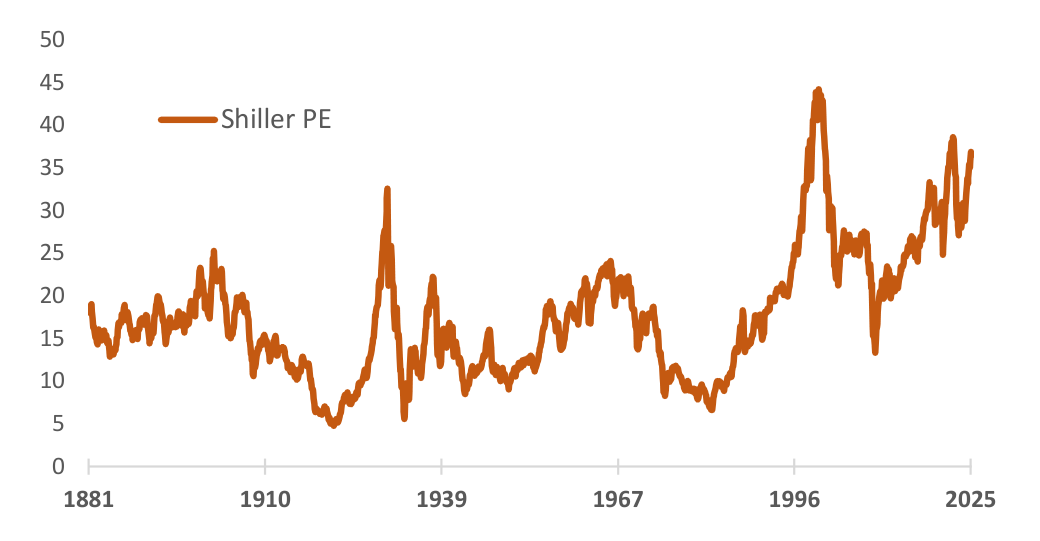
You may be familiar with the precautionary tale of Tony Dye, the CIO of UBS P&D, who turned bearish on equities in 1995, only to lose his job just days before the top, five years later. In 1995-6 equity valuations were close to the upper end of their historic range, and the bearish call for equities did not seem that outlandish. However, looking back (with the benefit of hindsight), the case for a major market top was not there. The oil price was falling, and inflation was low and stable; furthermore, share prices were in confirmed uptrends. Oil, inflation and bond yields all turned in 1998-9 but did not reach troublesome levels for another year, at which point widening credit spreads and deteriorating momentum confirmed the negative short-term outlook for equities. In short, the market peaked with the macro fundamentals.
These days, investment firms are all too aware of the risks of making bold calls, partly because of the fate of Tony Dye and his ilk. However, investors are experiencing vertigo at these levels, particularly when a curve ball like DeepSeek comes along. For those that missed the reports, a Chinese company has managed to find a way to create a ChatGPT-like AI engine at a fraction of the cost, raising doubts about the outlook for demand for the sophisticated chips manufactured by the likes of Nvidia whose share price fell 16% in response. Is this the start of an early 2000s-style bear market in America? I do not think so, or at least not yet, for the following reasons. Inflation is low and stable; the oil price has firmed a little but remains rangebound; bond yields have also risen but have eased back of late (and negative sentiment suggests limited upside for now); corporate spreads are tight, and momentum is positive. In other words, the macro fundamentals remain broadly supportive.
DeepSeek is an inevitable development in what should prove to be a long-term AI adoption story. If they have found a way to strip more value from chips, the ultimate result should be more demand, just as labour-savings technology has created new jobs, contrary to the fears of the Luddites. Besides, even if this is unwelcome news for Nvidia, cheaper AI would be good news for everyone else. This news does not challenge US exceptionalism, which is based on the pro-growth agenda of Donald Trump. Indeed, this news may cause Trump to double-down on his America-first program. Meanwhile, Europe is heading in a different direction, which is the subject of my next article.
At the start of January, the overall backdrop for US equities was as positive as it had been since June 2022, which itself was a good entry point in the market. During the late 1990s bull market there were three curve balls, none of which precipitated the widely anticipated sustained bear market: Greenspan’s “irrational exuberance” speech (1996), the Asian crisis (1997-8) and the collapse of LTCM (1988). The market kept bouncing back because the fundamentals were broadly supportive. There may be more downside to the Nvidia share price (I am agnostic about that) but this does not feel like the beginning of a big bear. But if commodities and inflation were to take off, now that would be a different story.