Article 56
Travelling hopefully
As the dust has begun to settle on the US election, Westminster Asset Management Investment Strategist, Peter Lucas, discusses the options ahead for President-elect Trump. Peter suggests that in reality Trump will have few options to deal with America’s underlying structural problems.
Ahead of the US elections, many were braced for riots and worse, with neither side expected to graciously accept defeat. In the event, the margin of victory was so big that the election passed without incident, with Democrats seemingly too shellshocked to make a fuss. Although the inauguration is still some way off, Trump’s team and gameplan are taking shape and the markets like what they see. The appointments of the billionaires – Scott Bessent and Elon Musk – has captured the imagination of the investors and raised hopes that Trump 2.0 will really deliver this time. But as Robert Louis Stephenson once said, “it is better to travel hopefully, than to arrive.” Or, perhaps more pertinently, as former heavyweight champion Mike Tyson said, “everyone has a plan until they are punched in the mouth.” This is the easy bit. Dealing with America economic problems will be easier said than done.
Someone recently pointed out that Biden took just six months to do something that had taken previous administrations over a century to achieve, namely raising the national debt by a trillion dollars. With the government interest bill close to record highs despite much lower interest rates, and with demographic trends projected to put even greater strains on the budget position, this situation does not look sustainable. That does not mean that America is going to imminently default (mainly because their debts are in a currency that they can print), but if nothing changes, crisis is probably inevitable. But what can be done?
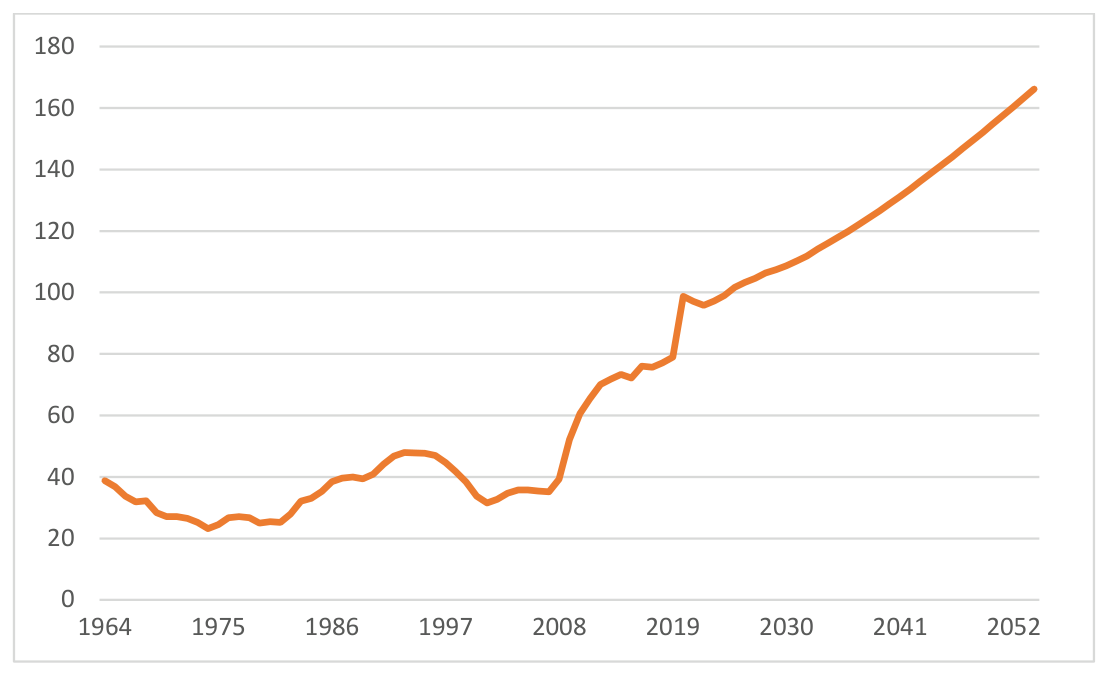
The short is: “depressingly little”. The size of the problem is simply too great. The Congressional Budget Office is projecting that the national debt will almost double in the next thirty years, partly because of demographics and what it will do to tax revenues and entitlements. As was demonstrated by the Cameron Tory government in the UK, austerity will not work because it kills the economy and reduces tax revenues. Could AI boost productivity and raise the economic growth rate sufficiently to make a difference? Whilst possible, it does seem a bit of a reach.
The fact that Musk was able to reduce X’s payroll by 80% with little or no discernable change in service levels has raised hopes that the new Department of Government Efficiency (DOGE) will do the same for the government. That, combined perhaps with a simplified tax code, would help enormously, but there will be the inevitable union backlash, plus job losses will hurt the economy short-term and might prove unpopular with voters (something a populist like Trump might not have the stomach for). Indeed, any weakening in the economy will likely be met with more government largesse. That combined with lower corporation taxes means that the deficit is not going to shrink anytime soon, leaving inflation as an ever-present threat.
The Trump tariffs are arguably the most controversial part of his economic agenda. The spread of free trade around the world delivered huge benefits in the decades that followed the collapse of the Berlin Wall, and most economists agree that turning the clock back on that would be bad news for both growth and inflation. More recent interviews with Trump’s team have indicated that tariffs are just a negotiating ploy, designed to turn up the heat on America’s trading partners to extract better terms. If so, that is better than the primitive protectionist thinking that helped to precipitate the 1930s depression. However, it is a risky ploy that, in the current chilly political climate, could easily descend into a tit-for-tat trade war. And with the emerging world pulling closer and closer together, America’s negotiating position is arguably not as strong as it used to be.
Trump’s economic agenda is ambitious, thought provoking and more than a little controversial. However, some of the plans will be tricky to execute and overall, will probably only buy America some time rather than a full reprieve. That is partly because there are things beyond America’s control that could blow his budget arithmetic out of the water. For instance, Trump might be turning his back on the green agenda, but many countries are committed to what will be very costly reforms. Many view these expenditures as non-negotiable, but there is no doubt that they will leave many heavily indebted countries in an even more precarious position. Meanwhile, the bifurcation of politics is weakening the core of Europe at exactly the wrong time. If, as seems likely, Europe slips back into crisis, America will be hit by an economic tsunami that could undo many of Trump’s best laid plans.
Like him or loathe him, America now has a leader that seems to have a better appreciation of the challenges ahead and a willingness to do things differently. However, the rest of the developed West is on a different path, which will mean that they will reach the point of crisis sooner, thereby taking Trump’s goals out of reach. US markets will continue to outperform until investors finally work that out.