Article 54
Currencies in a turbulent world
In this article Westminster Asset Management Investment Strategist, Peter Lucas, discusses currency markets with a particular focus on the US dollar. Peter suggests the current universally bearish views on the greenback may be misplaced.
In recent years my preoccupation has been inequality, debt and unhelpful demographics, and their impact on politics, economic conditions and the markets. My message has been that this is ultimately a recipe for instability and economic crisis. Ten years ago, that probably sounded fanciful, but now, not so much. As far as the markets are concerned, my focus has been on the likelihood of higher inflation and what that means for bonds, equities and commodities. But what about currencies?
Let’s start by examining why the consensus is so pessimistic about the medium- to long-term outlook for the US dollar. First, there is the issue of valuation. As the chart below attests, it is relatively expensive by historical standards, which means that in the very long run the dollar is all but certain to weaken versus other currencies. Second, there is the question of the ‘twin deficits.’ Although the combined size of the budget and current account deficits has shrunk of late, it is still close to the pre-COVID record and is bigger than it was in the 1980’s, the last time that the deficits were a market-mover. Third, there is the property market, which by some measures is the most overvalued since at least the 1980’s. Fourth, there is the fractious nature of American politics, which is making it hard to get anything sensible done and has means that fiscal tightening is off the agenda for the foreseeable future. And finally, there is the possibility or likelihood that the winner of the Presidential election will attempt to drive down the dollar to promote local the interests of American businesses.
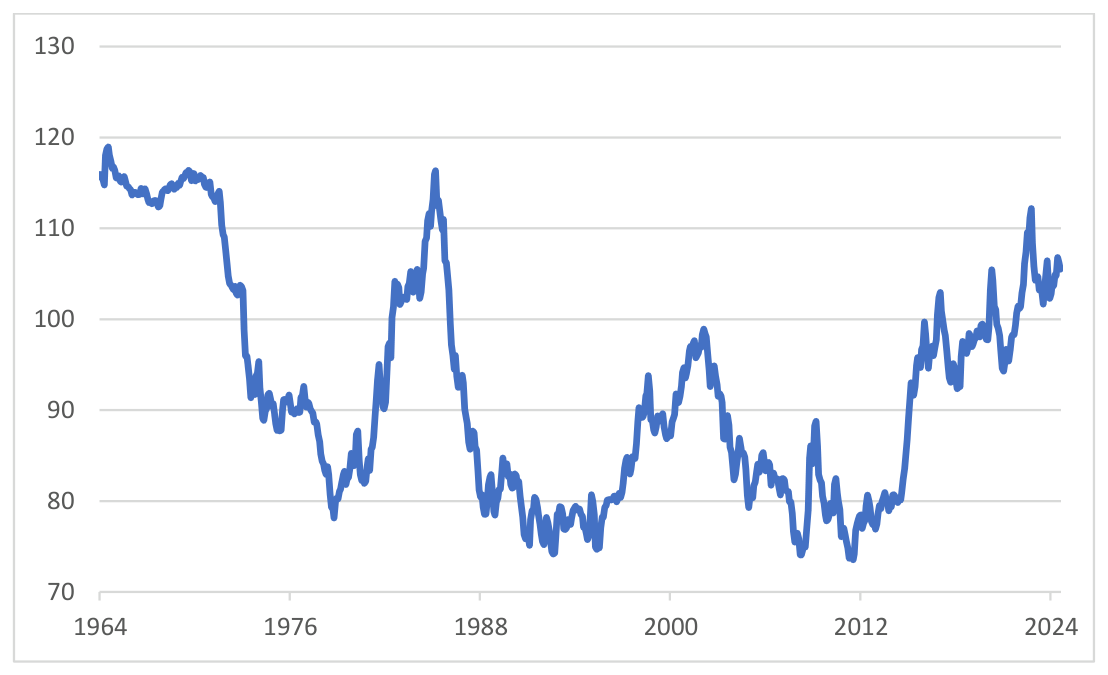
It all points to an open and shut case. Until that is, you remember that for the dollar to go down, another currency must go up. And that is where things get complicated, as almost every wealthy country has its problems. The UK is still dealing with the fallout from Brexit. Japan has a shrinking population. Canada, Australia, New Zealand and Sweden all experienced property bubbles that were every bit as big as that of America, if not bigger. And almost all share America’s problems of massive debts and political instability. In summary, they all have their problems, but at least America boasts the biggest and most liquid financial markets and plenty of military muscle. Many have described the dollar as “the least dirty sock in the draw.” It is not great, but what else are you going to own?
It is also worth reflecting on the fact that the dollar is still anti-fragile. In other words, it is one of the few currencies
- along with the Swiss franc and perhaps the yen – that investors flock to when the chips are down. And given that we are living in increasingly precarious times, it seems more likely in that sense that the dollar will go up rather than down.
Which brings me neatly onto what will probably be the biggest currency story, namely the euro. The 2008 financial crisis marked an important turning point for the euro. Not only did it represent its high point from a valuation perspective, but it also marked the beginning of a very challenging period for the Eurozone, both politically and economically. ECB chief, Mario Draghi, bought the euro some time with his pledge to do “whatever it takes,” but that seems like a lifetime ago, and cracks are once again appearing in the euro’s edifice. Most notably, inequality and uncontrolled immigration are pushing voters into the arms of some ‘interesting’ political parties, some of whom have no love for the single European currency.
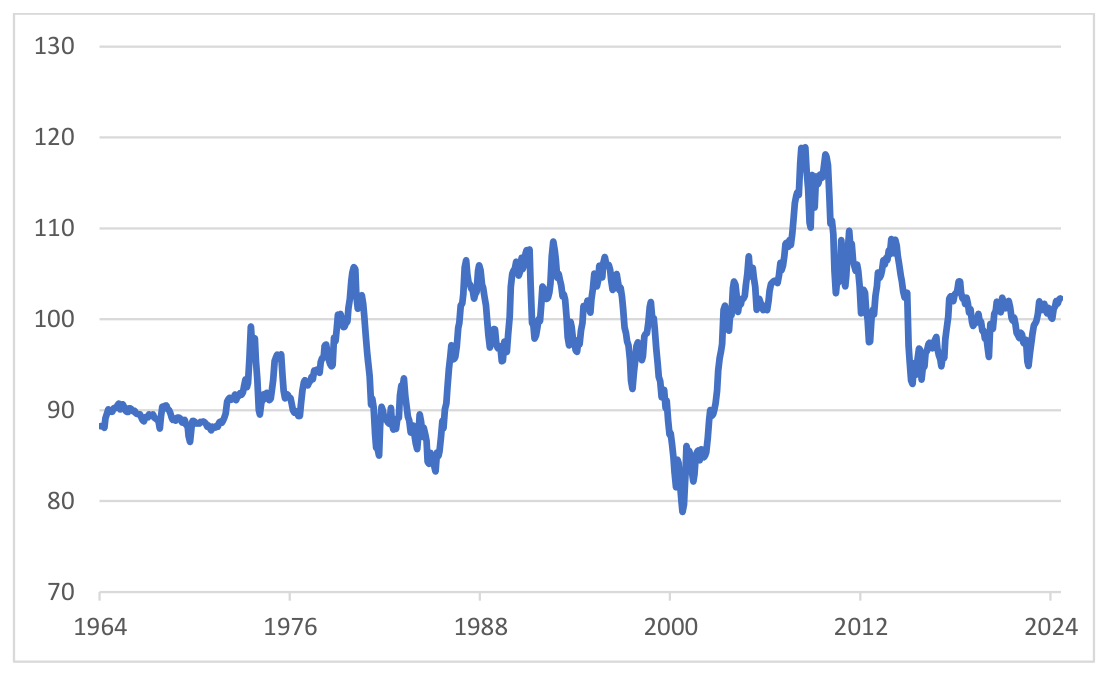
Most worrying of all is the fracturing of French politics at a time when the country is grappling with the biggest debts in the region. You know there is something wrong when 5-year French bonds yield more than equivalent Greek bonds. It all looks rather ominous. This does not mean that the euro is at immediate risk of collapse, but my sense is that it is something that we should be thinking about and perhaps, even preparing for. And if the euro were to get into real trouble, it would represent one of the biggest threats to stability in modern times, potentially even eclipsing the financial crisis. Under those circumstances, which currency do you think investors would flock to? The pound? The yen? I don’t think so.
The current focus of investors is the US economy, which seems to be heading for a soft- or even no-landing scenario. Having taken advantage of cheap fixed rate deals when interest rates were on the floor, households and businesses have been insulated against one of the most aggressive tightening cycles since the late-70’s. This seems to have a decisive factor behind the resilience of the US economy. However, both will have a rude awakening as these cheap deals mature. In short, this resilience has a shelf-life. The dollar has recently rallied as the odds of more rate cuts have receded, but that might not be sustained beyond the near term given that a better economy should be good for markets and bad for a risk-off currency like the dollar. The impending election might also cool investors’ enthusiasm for the dollar. Or could it be that political chaos motivates investors to buy the dollar, much as the downgrading of US Treasuries caused investors to buy bonds? Stranger things have happened.
Forecasting currencies is notoriously tricky, but with a gun to my head, my view would be that the dollar will continue to range trade for the time being, but when the break comes it will be to the upside. There are plenty of geopolitical risks that could trigger such an outcome, but a euro crisis would produce the most fireworks. However, if a strong dollar happens just as the cheap interest deals are rolling off, the subsequent downturn in the US economy could be surprisingly sharp, leading to major efforts to boost the economy and undermine the dollar.
The most important observation here is one that I made many years ago. If all the major economies (the emerging world excluded) are in the same boat and no currency can pick up the slack from the others, the outcome will be a general devaluation of currencies against real assets. I believe that this process has already begun with gold and will ultimately spread to the whole of the commodity complex.