Article 52
Eurozone in Crisis (again!)
In this article Westminster Asset Management Investment Strategist, Peter Lucas, looks at President Macron’s surprise election announcement and considers the bifurcation of politics, a result of the popularism he anticipated years before it became a mainstream theme, and its impact on the markets and ultimately, the Eurozone too.
My last strategy note was circulated three weeks ago (“Inflationary boom,” 14th May 2024). My focus was on our US economic indicators, which were signalling that both economic growth and inflation were gathering momentum. Historically, such a mode has been good for commodities and bad for bonds, with equities somewhere in between. Indeed, I said that the best hope for bonds was a loss of confidence in the equity markets, where sentiment was looking a bit overcooked.
Something that was not in the note – but was discussed at our last in-house strategy meeting – was the possibility of a short, sharp rally in bond prices. Although the indicator evidence did not support such a move, the ‘Technical’s’ (chart patterns) seemed to be leaning that way. We discussed what could spark such an ‘unlikely’ move, and agreed that geopolitics was the most likely candidate. And with two wars on the go, multiple elections, and building social tensions, it was quite easy to see how that could happen, even if the specifics were not clear at the time.
I have been doubtful about the sustainability of the euro from the very beginning, but even as the region lurched from crisis to crisis, it has limped on, bloodied but unbowed. However, as I have argued – as recently as March (“Four years on”) – political and economic trends meant that its greatest test would come in the years ahead.
The weekend before last saw the latest round of European parliament elections. In France, the euro-sceptic National Rally party under Marine Le Pen made big gains at the expense of the centrist En Marche party under Emmanuel Macron, raising fears that France’s membership of the euro may be in jeopardy. These fears were heightened by the President’s decision to dissolve parliament and call a snap parliamentary election, presumably in the hope that the European parliament election was just a protest vote. Since then, we have seen the left-leaning parties club together, raising the risk that Macron’s centrist party will be squeezed out those on the left and the right.
To me, the biggest mystery is why Macron’s party has enjoyed so much success before now. I have written about the bifurcation of politics resulting from increasing inequality and the cost-of-living crisis. Angry voters have sought redress from both extremes of the political spectrum – state support and redistribution from the left and anti-immigration policies from the right – abandoning the centrist parties that have been blamed for all these problems. When he first came on the scene, Macron’s party was perceived to be new and exciting, but the realty was that it was more of the same. It is amazing that it has taken French voters this long to work that out.
The past week has been tricky for French assets and Europe in general. The CAC40 fell 6%, with financials down over 10%. The spread of French 10-year bonds versus Bunds widened to 76, a level not seen since 2017 and the Eurozone debt crisis before that. If things continue in this vein, we can expect a policy response from the Eurozone and the ECB. They have too much invested in the project to let it go without a fight. However, their options are limited. I am sure they will try to scare French voters into thinking twice about backing Le Pen, with much focus on the recent turmoil in the markets. However, ‘Project Fear’ did not work in Britain and has a good chance of backfiring in France. The ECB has been a key player in keeping the euro show on the road. But this is a very different world to when Mario Draghi pledged to do “whatever it takes” to defend the euro. Inflation might be back to where it was when he uttered those words in 2012, but the overall inflation environment is now quite different. Unleashing more quantitative easing at this juncture would likely prove counterproductive in the fullness of time.
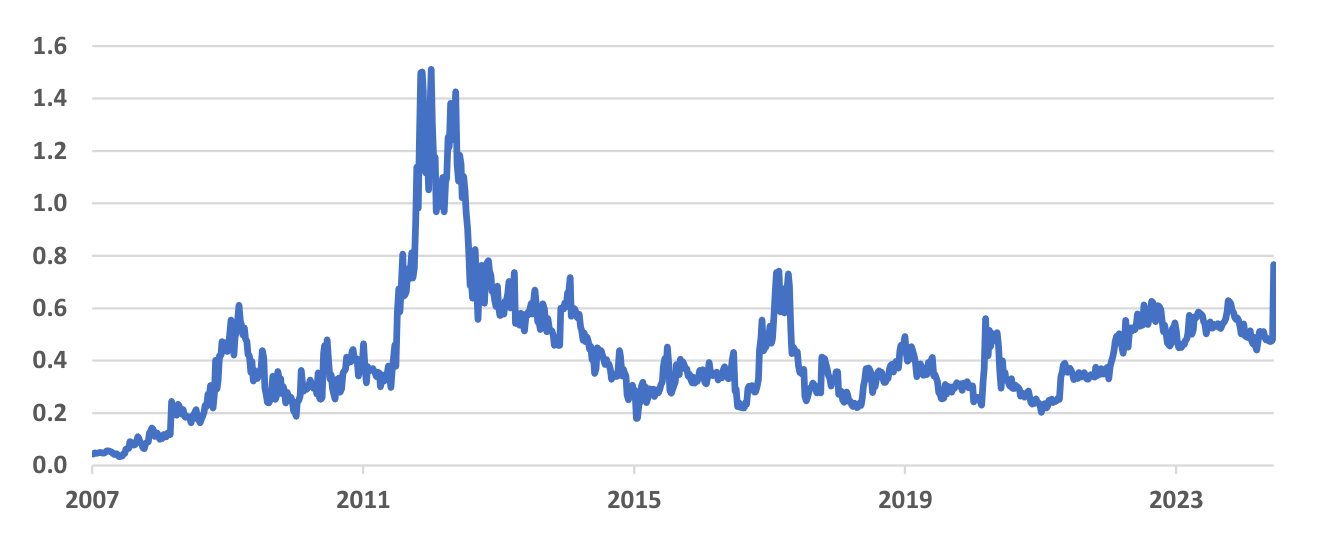
Chart 1: France-Germany 10-year yield gap in %. (Source Bloomberg/Westminster Asset Management)
There are two more points worth making here. FREXIT would be disastrous for the French economy and for European markets generally, at least in the short-term. If nothing else, imagine how hard it will be for companies and investors to work out who owns what to whom and in what currencies. However, according to the IMF, France is the most indebted country in the Eurozone, with private and public sector borrowings of over 360% of GDP and so it may be that France ultimately has no choice but to leave the euro and devalue the new franc. The second point is that France is arguably the lynchpin of the euro. If France were to leave, it would probably be game over for the single currency.
But I am getting ahead of myself. This may well be just the end of the beginning rather the beginning of the end of the euro, but this is an important milestone on that journey. But if the crisis does intensify in the near term, there is every chance that most (but not necessarily all) bonds will continue to rally. Indeed, recent breaks of trend suggest that is the most likely outcome. But be under no illusion, as far as government bonds are concerned this is just a continuation of the ‘rally in a bear market’ that began last October. Higher yields are expected down the line.