Article 51
Covered Call ETFs
In this article Westminster Asset Management Investment Strategist, Peter Lucas, looks at Covered Call ETFs and their potential usefulness for absolute return investors by reviewing historic performance in differing market conditions.
In the past four years, I have often returned to the theme that a less conventional approach to investment management will be called for in the years ahead given the likelihood that traditional bond/equity portfolios will struggle to produce positive real returns.
One alternative strategy worthy of consideration is covered call writing, which can produce a decent level of income with roughly two-thirds the risk of pure equity. It involves buying shares and concurrently selling call options, which confer the right to buy the shares at a given price on or before a pre-determined date. In return for that right, the option buyer pays the writer a premium, the size of which will be reflective of the life and strike price of the option, as well as prevailing market volatility. In effect, the writer of the option is limiting the upside on their shares in exchange for an upfront payment.
Example :
Investor A buys 100 shares in Microsoft at $430 costing $43,000 and writes (sells) 1 contract (100 shares) of Microsoft $430 June 2025 call options to Investor B at $53 netting $5,300.
Scenario 1
Microsoft shares rise to $500 by June 2025. Investor B exercises the option to buy the shares from Investor A at $430. Investor A now has $48,600 (including four dividend payments) for a return of 13%, less than the profit that would have been made without writing the option, but a decent return, nonetheless.
Scenario 2
Microsoft shares fall to $350 by June 2025. There is no point in Investor B exercising the option which expires worthless. Investor A now has $35,000 worth of shares and $5,600 (including four dividend payments) resulting in a loss of 5.6%, not great but considerably better than the 17.9% loss inflicted by the ‘unhedged’ position.
The key points to note are these:
The covered call strategy outperforms ‘unhedged’ Microsoft shares providing the share price ends the period below $483.
- Investor A makes a positive return providing the share price remains above $374 ($430 start price minus $3 dividends per share and $53 option premium).
- The overall strategy generates a positive cashflow of $5,600 rather than just $300.
- Over the long term covered call portfolios have generally underperformed equivalent ‘naked’ strategies. However, as the above example demonstrates, they are less volatile, generate a higher level of income, and under certain market conditions, can experience periods of outperformance.
What circumstances favour covered call strategies? As stated above, the call writer is foregoing the unlimited upside on their shares in exchange for a fixed premium, so clearly covered call strategies tend to underperform when conditions are broadly favourable for equities. Important considerations in that regard include value (equities perform better when they are cheap) and fundamental variables like growth and inflation. In previous articles I have explored the relationship between equities and inflation, and I have demonstrated that they perform best when inflation is low and/or falling.
Option prices rise and fall with market volatility. In other words, in periods of uncertainty, demand for portfolio protection (including options) increases, leading to higher prices, all other things remaining equal. And higher option prices make it more likely that covered call strategies will match or even beat their ‘naked’ equivalents.
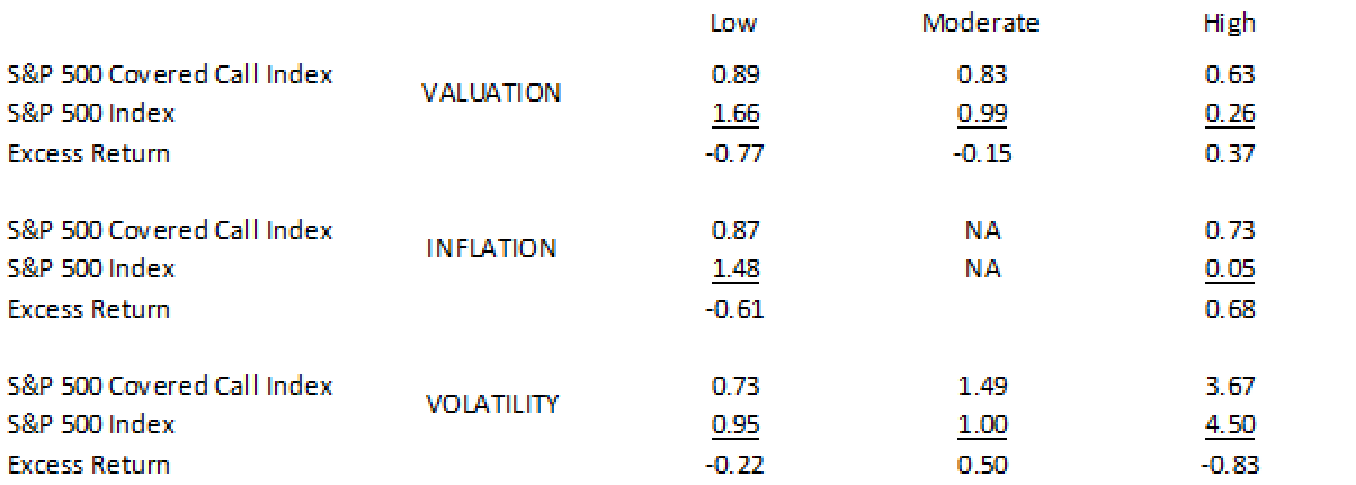
The above table gives performance numbers for both types of strategy under different market conditions, and it shows that covered call strategies perform best, at least on a relative basis, when equities are expensive, the fundamentals for equities are unfavourable and volatility is elevated but not extreme (very high volatility has historically led to sharp equity market recoveries).
How much extra income does option writing generate? The Chicago Board Options Exchange does not break down income and capital growth for their buy-write index. However, as an example of what can be achieved, the JP Morgan Equity Premium ETF (JEPI) – with assets under management of over $33bln – has an indicated dividend yield of 6.9% (down from a peak of around 13% in 2023), which compares very favourably with the 1.4% dividend paid by the S&P 500. Note that ETFs are a good way to gain exposure to this type of strategy in one handy package.
Hopefully, it should be clear by now that covered call strategies are a potentially useful addition to any investment toolbox. Furthermore, if I’m right, the future will deliver just the sort of environment that favours this type of strategy: more volatility and higher/accelerating inflation, combined with elevated equity valuations. In addition, in a world in which investors are becoming increasingly nervous about the size of government debts, covered call strategies offer a decent income producing alternative to fixed income securities. The one fly in the ointment is that fact that volatility is currently very low by historical standards, leaving covered call strategies vulnerable to an increase in volatility in the short-term. However, once volatility steps up, they will benefit from the higher revenues that accrue from selling options at higher prices.