Article 48
Four Years On
In the middle of 2020, I wrote a series of articles outlining my medium/long term view on the economy and financial markets. I would like to revisit what I said back then and to bring the story up to date.
The first article (“The Global Outlook from 2020”) explained why growth and inflation were so low in the decade following the 2008 financial crisis. In addition, it started to outline how that period of relative calm would end, highlighting overvalued markets and income inequality –products of easy monetary policy – as key factors in that process.
The second article (“The rise of the populists”) described how extreme inequality was leading to a breakdown in political allegiances: voters, unhappy with the status quo and seeking change, were deserting the middle ground, creating opportunities for populist politicians and extremists. In addition, free market capitalism was being blamed for sky-high property prices and rising living costs. The result of these trends was expected to be much easier fiscal policy, the return of big government, deglobalization, and generally higher inflation.
The third article (“Kicking the can down the road”) questioned the logic of central banks ‘rescuing’ economies with easier monetary policy given the way in which it leads to overvalued markets (and lower future returns) and ever more debt. In effect, a better today had been engineered at the cost of a much more uncertain tomorrow, and now the piper must be paid.
The fourth article (“When does a lot of debt become too much”) talked about the way in which COVID had (1) hastened the anticipated transition from tight to easy fiscal policy, and (2) heightened the threat of higher inflation. It also looked ahead to a time when central banks might be forced to reactivate quantitative easing – to prevent bond yields and government borrowing from spiraling out of control – the ultimate result of which would be higher inflation and ironically, much higher bond yields.
The fifth and final article (“Pulling it all together”) focused on the potential for bad policy making, rising inflation, high debt levels and overvalued markets to interact with each other, to produce a major economic and political crisis.
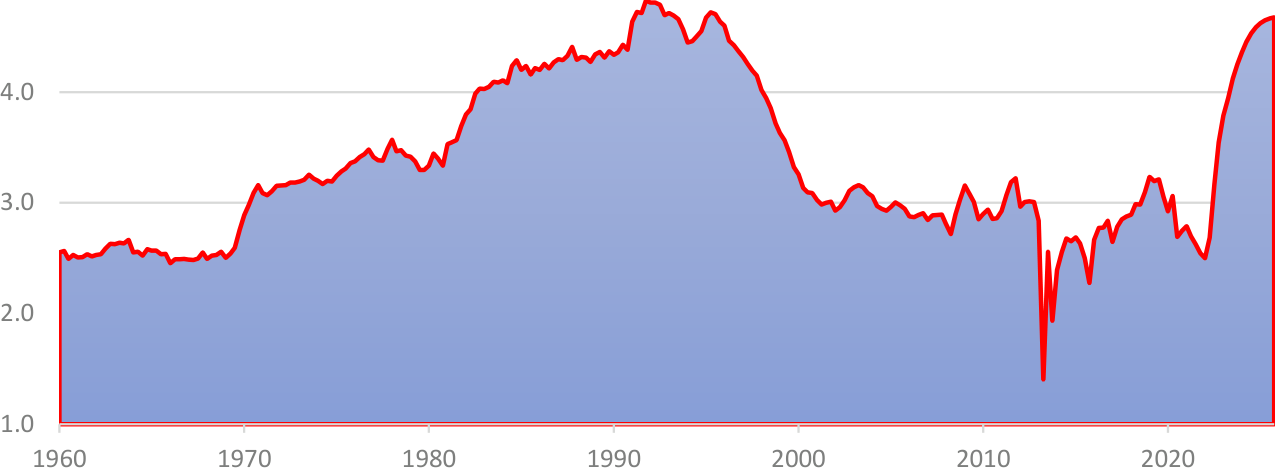
Chart 1: US Net Government Interest Payments as a %'age of GDP (projected to 2025) (Source: Bloomberg/OECD)
Much of what we have seen in the interim has conformed to this roadmap. COVID seems to have cured politicians of their squeamishness of big deficits and austerity has been confined to the policy dustbin. The Biden administration has presided over one of the easiest fiscal policies in decades and as I demonstrated in a 2021 article (“Baked in the cake”), large cyclically adjusted fiscal deficits are inherently inflationary. This fiscal profligacy is, I believe, a direct consequence of inequality and the cost-of-living crisis, which has left voters very grumpy, to say the least.
The political bifurcation that I described has continued, with right wing parties gaining ground in Italy, Germany, the Netherlands, France and elsewhere. For the first time, Marine Le Pen has been projected as being the next the French President. In America, it is looking like Trump, the ultimate populist, will be the next American President. As countries become more inward looking, globalization will continue to unravel (with dire consequences for both economic growth and inflation) and international relations will become more poisonous, raising the risk of more wars, cold or otherwise.
Although inflation reached levels not seen for decades, it has fallen back in the past year or so. Indeed, at the start of the year, investors were supremely confident that central banks would successfully get inflation back to target without pushing economies into a recession, deep or otherwise (a soft-landing). Although there are grounds for optimism – COVID-related bottlenecks have eased, productivity growth has increased, and property related inflation will almost certainly continue to drop through 2024 – the fact is that inflation indicators are already starting to bottom out. Whatever the short-term outlook, there are still plenty of reasons to think that inflation will be higher than we have been used to in the long run, including the green agenda, deglobalization, easy fiscal policy, war, and the return of big government.
Looking to the future, I see several potential flashpoints:
• Social instability, pitching left against right, and climate change activists against victims of rising living costs. People that vehemently believe that the planet is in peril will not back down without a fight. • Democrat-run US states, which are being hollowed out by capital and human flight triggered by rising crime, high taxes, and deteriorating finances. • The integrity of the Eurozone, which may be threatened by a combination of deteriorating finances and the rise of euro-sceptic parties. • Spreading conflicts (“When all else fails, they take you to war”, Gerard Celente). • Government bonds. The risk is that rising borrowing costs interact with big debts to produce a significant deterioration in budget deficits, necessitating money printing and various forms of financial repression, all with inflationary consequences. Investors are clinging to the hope that central banks are still in control; another inflationary cycle would lead many to question whether that is indeed the case. • Highly priced equities, which, as we saw in 2022, will struggle in an environment of rising inflation and interest rates (see “Equities for the long-term #2” for a fuller explanation of the relationship between equity valuations and inflation).
In what should prove to be an increasingly challenging investment environment, investors should give preference to assets that will confer some degree of inflation protection, including:
• Low priced value equities. • Commodities. • Inflation-linked bonds (now offering positive real yields again). • Short-dated corporate bonds.
• Infrastructure. • Asia equities and Emerging markets.
I started telling this story in 2014 under the speech title of “Passing through the eye of the storm”. At the time, although the direction of travel seemed right, events seemed to be unfurling at a snail’s pace and the expected crisis seemed a distant prospect. But then COVID sped the descent into fiscal unsustainability and everything now seems to be unfurling at a rate of knots. In my very first paragraph for Westminster, I said: “traditional investment portfolios that have served investors so well for the past forty years, could prove to be as destructive to wealth as they were in the 1970s”. That is exactly what we saw in 2022 and I suspect that we will see more of the same in the years ahead.
Related Articles