Article 41
Winter is coming
Westminster Asset Management Investment Strategist Peter Lucas believes there is an ill wind blowing for risk assets, but do not despair. The onset of recession will start the countdown for the next buying opportunity.
Back in late February I reiterated my cautious view on markets. Heeding the message of the steep yield curve inversion, I said that there was a good chance that the US economy would enter recession in the months ahead. If history was any guide, this would mean that bonds and gold would prove to be superior investments to equites and cyclical commodities. Markets like Europe and the UK, which had outperformed the US since October, would find it harder to break the gravitational pull of a bearish Wall Street. The Japanese equity market was cited as one place that investors might like to wait out the coming storm.
Almost three months on, we can see that the markets have broadly conformed to expectations. Most equity indices are flat or down, with the equally weighted S&P 500 index down 3%. Japan has been the best performing major equity market. Meanwhile, bond yields have generally fallen, with the US 10-year Treasury yield down over 40 basis points and the Bloomberg US Treasury index up 3%. The gold price has risen 11% and cyclical commodity prices are generally lower.
| Chg* | Chg* | ||
| S&P 500 | 3.21% | US Generic Govt 10 Yr | -41.6 bps |
| S&P500 Equal Weight | -3.52% | US Generic Govt TII 10 Yr | -24.5 bps |
| Russell 2000 | -7.65% | Bloomberg US Agg Corp YTW | -22.0 bps |
| S&P 500 Value | 0.18% | UK Gilts 10 Yr | +23.8 bps |
| S&P 500 Growth | 6.01% | German Govt 10 Yr | -20.1 bps |
| NYSE FANG+ Index | 15.78% | ||
| S&P 500 Energy Sector | -3.05% | Gold Spot price per oz | 11.31% |
| MSCI EMU | 0.64% | S&P GSCI Ind Metal Spot | -5.98% |
| NIKKEI 225 | 7.44% | S&P GSCI Energy Indx Spt | -4.08% |
| MSCI EM ASIA | -0.58% | S&P GSCI Agric Indx Spot | -5.91% |
| MSCI EM | 0.02% | ||
| FTSE 100 | -2.27% | Dollar Index | -2.75% |
| Platinum price per oz | 16.54% | British Pound Spot | 4.74% |
*Local currency price/yield change (22/02/23-10/05/23), source: Bloomberg
Not everything has gone according to plan, however. Europe continues to enjoy a tailwind of falling energy prices (the German natural gas price is now down 88% since late August) and has been more resilient than expected. The cap-weighted S&P 500 is up 3% due to a handful of large cap growth companies (more on this shortly), which have been bid higher by safe-haven flows. And despite offering better value (yields versus trend economic growth) than German or US bonds, UK Gilts have seen yields rise due to stubbornly high inflation (to the benefit of the pound).
As monetary conditions tighten one is never quite sure where the first cracks will appear in the economy. In my last note, I highlighted residential property as an area of particular concern, but in the event, it has been the regional banks that have been in the spotlight, hammered by a nasty cocktail of deposit withdrawals (in pursuit of higher rates elsewhere), balance sheets damaged by big falls in bond prices and inverted yield curves (reducing returns from borrowing short-term to lend long). Three US banks have failed, and the regional bank index has fallen by almost a third. No doubt this stress will lead to even tighter bank lending standards, thereby exacerbating the descent into recession.
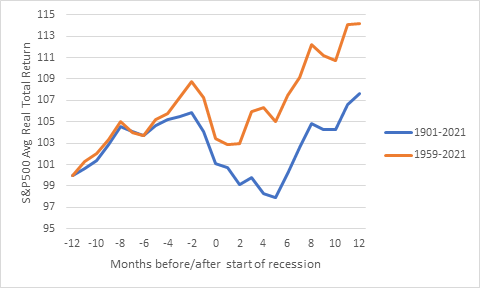
Given the history of yield curve inversions since 1960 as my guide, it looked likely that the recession would begin in the third quarter of 2023. If that is so, history also says that we are now entering the period of maximum vulnerability for the US equity market (see chart below). This is very much supported by the broader indicator evidence, which continues to favour bonds and gold over equities and cyclical commodities.
The fact that a small number of very large companies are propping up the broader indices (poor market breadth) is concerning from two points of view. First, proper bull markets are usually supported by rising share prices across a broad front, something we are not seeing today. Second, the degree of outperformance by the mega-caps looks to be reaching its limits. The top five stocks now account for 20% of the S&P 500, which is an unusually high percentage by historical standards. Furthermore, the valuation gap between them and the rest of the market is approaching the high posted in August 2020. The risk is that the so-called ‘generals’ join the troops in a recession-led market downturn.
In summary, my view on markets remains much as it has been since last August. It’s safety first, with a preference for bonds and gold over equities and cyclical commodities. However, as soon as the indicator evidence says that the recession has begun (we are not quite there yet), that will be the first sign that we should start looking for opportunities to rotate back into riskier assets.