Article 39
Confessions of an Ex-landlord
Our Investment Strategist, Peter Lucas, ex-Landlord and previous Chair of the Jersey Landlords Association considers the outlook for Jersey property investment in Part 2 of a 2 Part series.
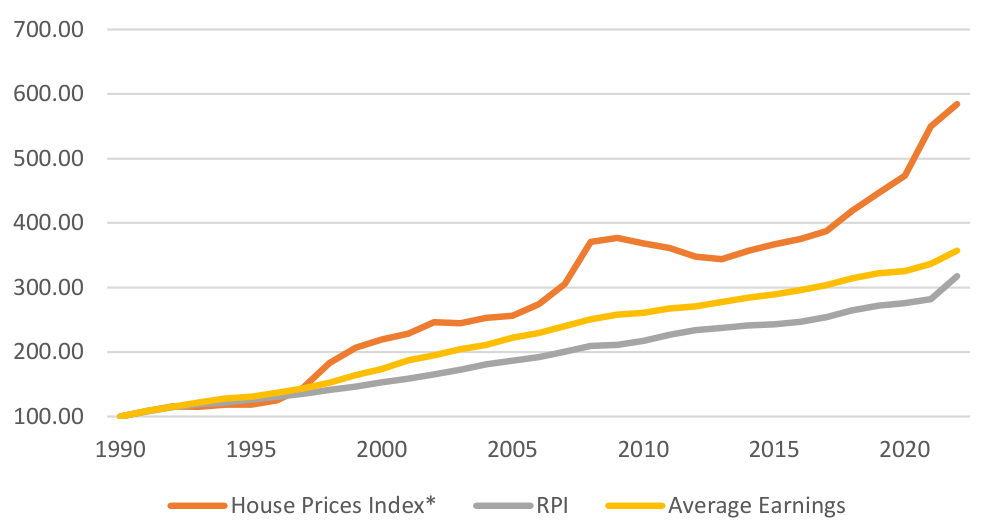
Jersey property has been something of a one-way bet since the 1980’s. According to Open Data (gov.je), the average house price has risen twelve-fold since 1985, outstripping both consumer prices and average incomes in the process. They briefly flatlined in the early 90’s recession and dipped a bit after the 2008 financial crisis, but in both cases hit a new record high within five or six years. Like all great bull markets, this one has made fools of the sceptics and bestowed an aura of invincibility upon the asset class. Nonetheless, two years ago I called time on my short career as a landlord. In this article I will explain why I sold and why I think financial assets will be a better home for my money.
I enjoyed being a landlord. I bought conversions – properties that had been converted into flats – which in my case were typically in need of some TLC. With the help of a good builder, I turned the properties into nice living spaces, whilst enhancing the value of the building at the same time. I struggle to understand why landlords do not maintain their properties, particularly when most refurbishments are tax deductible.
I bought my first rental property in 2016. The UK had just voted to leave the EU, the pound was in freefall and interest rates had just been cut. Fixed mortgage rates were on the floor, and I decided it was too good an opportunity to miss. I bought my first property that November, and two more were to follow in the next three years. I was expecting inflation and interest rates to rise sooner or later, and owning real assets funded with fixed rate borrowings struck me as a sensible way of positioning for that.
As it happens, nothing much happened on either front for the next four years. But that seemed to suit the property market just fine, with prices ticking gradually through time. And then along came COVID. When the lockdown policy was instigated, there were many that thought that property prices would take a hit. I took the opposite view, arguing that low interest rates and money printing would result in higher prices. In the event, not only did prices rise, but the rate of increase accelerated.
Some rudimentary valuation analysis in 2016 had revealed that the ratio of Jersey property prices to average earnings was slightly above the historic average, but 15% below the 2008 peak. Not screamingly cheap, but not a bad entry point. I concentrated on one-bedroom flats. Although smaller units meant more tenants and more work, there were significant compensations in the shape of higher yields and greater diversification.
As much as I was enjoying life as a landlord, I was increasingly uneasy about the risks that appeared to be stacking up against the property market, many of which still apply today:
Jersey property is an expensive asset in what has become an expensive island. Jersey’s high cost-structure will be an obstacle for the economy, and stagnating household earnings will put a lid on property prices. With governments around the world strapped for cash, particularly after COVID, there is a risk that they will decide to ‘tighten up the financial plumbing,’ to the detriment of offshore jurisdictions like Jersey. It might be the low probability outcome that many think it to be, but were it to happen, the consequences for our economy and property prices would be disastrous. Rising property prices have pushed up rents and priced aspiring property owners out of the market. Inevitably, politicians have started to get involved, to the detriment of the rental sector (more on this shortly). Back in 2020 Interest rates were still close to zero, but with inflationary risks building due to lockdown-driven supply bottlenecks, I expected that to change, thereby making it more difficult for first-time buyers to get on the ladder.
Faced with the possibility, or probability, of a stagnant economy, unhelpful government policy and rising interest rates, I reluctantly exited the Jersey property market in 2021.
The world never evolves as quickly as I expect it to, and it soon became clear that I had moved a little too soon. Jersey property valuations have correlated over 80% with real (inflation-adjusted) interest rates since the 1980’s, and as rising inflation pushed real interest rates deep into negative territory, the rise in property prices went into overdrive, taking valuations to new record highs.
Galling as it was to miss that last jump in prices, I kept reminding myself that it was always easier to sell in a rising market and that being early was hugely preferable to being late. Furthermore, when things did finally start to happen in 2022, the change in the environment was dramatic. Having essentially flatlined just above zero since the financial crisis, mortgage rates rose at a pace not seen since the late 1980’s. Properties that were barely affordable when interest rates were on the floor, were suddenly snatched out of the reach of many first-time buyers.
To make matters worse – as I feared – our politicians are getting involved. They see high property prices as a local problem requiring local solutions. Furthermore, they seem to view them as a failure of capitalism, which requires the corrective hand of government. I think they have it the wrong way round. High property prices (as well as inequality and stagnating productivity) are all global (rather than local) problems and are the direct consequence of ultra-low interest rates. And interest rates are only low because Central Banks decided that they should be that way. In other words, if there is a failure, it is in the Central Bank model rather than in capitalism.
Nonetheless, lots of voters are unhappy with the status quo, and the government feels the need to do something. We have already seen the introduction of a 3% stamp duty surcharge for purchases of second homes (including buy-to-let) and a rent control tribunal is in the pipeline. I suspect that we will see more such measures that will do little to address the valuation problem (which is already being addressed by higher mortgage rates) but will undermine the rental sector and lumber the economy with more red tape. Incidentally, this is all in keeping with my long-term view that politicians around the world will attempt to ‘fix’ capitalism to everyone’s detriment (see my article “The rise of the populists”, June 2020).
Readers of my Westminster strategy notes know that I have my concerns about the decade ahead due to a challenging cocktail of excessive government debt, extreme inequality (unstable politics), overvalued markets, unhelpful demographics, and the Green Agenda. I expect inflation to be generally higher and more volatile than in previous decades, which will make for a challenging investment environment. Given those beliefs, some might reasonably say that I have simply jumped out of the frying pan into the fire, which to some extent would be fair comment. Buy-and-hold financial assets are probably not going to be a great investment either. But there is the rub. Financial assets are much easier and cheaper to deal than property, which makes it much easier to tailor a portfolio to suit the changing investment environment. And that could make the difference between a satisfactory investment outcome and a bad one.