Article 37
Patience is bitter, but its fruit is sweet
Westminster Asset Management Investment Strategist Peter Lucas thinks risk assets have gotten a little ahead of themselves, but the outlook for a recovery later next year is building.
This is my first strategy article for some time, largely because there has not been much to talk about. At the time I said that there was a good chance that the US economy would enter a recession and that government bonds should therefore be favoured over equities. For a while we saw the opposite, as – somewhat strangely – equity investors saw fit to celebrate the fact that the Fed was going to raise interest rates at a slower pace. With indicators like the yield curve, the Conference Board leading indicator and ISM inventories minus new orders all at levels that have been associated with recessions, I could not see the logic of that, particularly with the Fed targeting a lagging indicator like inflation.
More recently, things have started to make more sense, at least to me. Bonds have continued to rally in response to evidence of decelerating growth and inflation and equities have stumbled, with the S&P 500 breaking its short-term uptrend. But it is still too early to hang out the flags. Although the long bond has outperformed the S&P 500 since late October, it has yet to get back to where it was on a relative basis at the time of my last article. But my sense is that this is just the start of a bigger move.
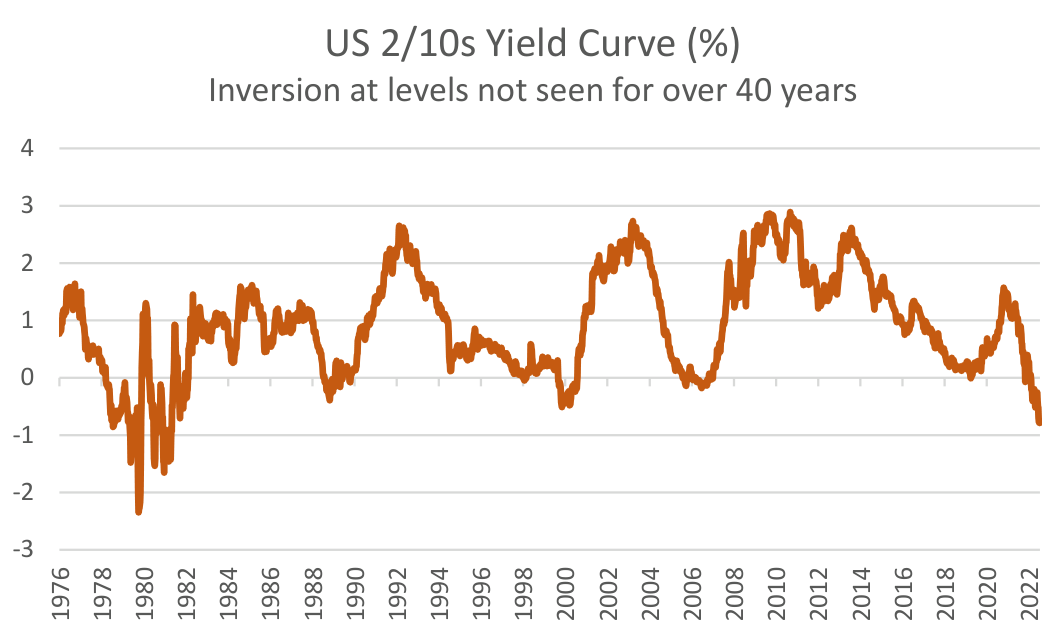
Eventually, falling inflation will allow the Fed to respond to deteriorating economic conditions, at which point the outlook for risk assets will improve, with the caveat that it is quite normal for equities to continue falling well past the peak in interest rates. As a rule of thumb, having experienced a two-year-plus bear market, I am expecting bond prices to rally for 6-9 months, pointing to a high sometime around mid-2023. The next major high in bond prices should be lower than the last, given my expectation that any drop in inflation will be transient. In other words, any recovery in bond prices will take the form of a rally in a longer-term bear market.
Talking of bonds, this may be a suitable time to revisit my comments on the gilt market. In late September, with ten-year gilts yielding 2% more than its German equivalent, I suggested that the gilt market had overreacted to the events surrounding the Truss/Kwarteng budget, thereby creating an investment opportunity. Much has happened in the intervening weeks: Kwarteng and Truss have gone, replaced by the more cautious Jeremy Hunt and Rishi Sunak. Consequently, the Gilt-Bund spread has shrunk from 227 basis points to 127 and the benchmark 10-year bond has rallied over 17%. That is a nice turn, but with the spread still wide by historical standards and with the Tories returning to austerity, the short-term outlook for gilts remains positive.
Although the outgoing leadership team displayed political tin ears, they were probably on to something with their pro-growth budget. The post financial crisis policy mix of austerity, QE and ultra-low interest rates proved to be disastrous for productivity and growth, plus it drove a massive wedge between the haves and the have-nots. Whilst there are no good policy options here – only less bad ones – an easy fiscal-tight monetary policy mix would probably have worked out better for all than a return to austerity. It is just unfortunate that they did such a bad job of selling the concept and managed to upset almost everyone by prioritizing bigger bankers’ bonuses and tax cuts for the wealthy in the middle of a cost-of-living crisis. I am finding it hard to be optimistic about immediate prospects for the pound and the UK with this policy backdrop.
With all this doom and gloom, it is nice to finally get some good news, albeit in the East. In the face of widespread protests, the Chinese leadership has finally started to wind back its policy of zero- Covid. Chinese equities have responded positively, with some indices up as much as much as 30% since their October low. With infections spiking, the reopening of the Chinese economy is going to be hesitant and gradual, which means that the impact on the rest of the world will be minimal to begin with. However, in time this will help to cement the expected 2023/24 economic recovery and will cushion the downside for commodities prices in the months ahead.