Article 34
Scrimpflation and the Contradiction Economy
Senior Investment Director Ben Shenton opines on the changing economy and its effects on our lives and the way we invest.
During the first half of 2022 there were two phrases that caught my eye: “Scrimpflation”, and “the Contradiction Economy”. I felt that these terms would make an interesting topic for the first, of what I hope is many, interesting and informative articles explaining how the subject matter would affect the day to day lives of us all.
Everyone knows what inflation is, and we are all aware of what shrinkflation is, albeit many may not have known it had a name. Shrinkflation is where prices stay roughly the same but the size of your cereal box, chocolate bar, toilet roll, etc. goes down. It’s a good way of increasing profitability and margins if you believe your sales won’t be affected by the smaller item size, and a good way of passing on costs without your customer noticing.
To “Scrimp” is to be sparing in use, to be mean, to be stingy. The term Scrimpflation largely relates to the service sector and represents a situation where you are paying the same or more for services which have significantly deteriorated compared to service quality in the past. Many businesses are cutting back on service quality because they either cannot afford to maintain standards, or because they wish to save money and/or make bigger profits.
What does this mean? In the ‘good old days’ most restaurants had crisp white table clothes which look nice but are expensive to launder. They were there as part of the overall customer experience. They are disappearing in favour of a (much cheaper) contemporary look. Note the reduction in coffee sachets and biscuits in the hotel room, and the demise of the walk-in social security and tax departments in Jersey. It’s a do-it-yourself world. If your flight is cancelled, for example, you are on your own – rarely a customer service desk to help you. One airline abandoned me in the wrong city (after a technical fault caused a diversion) and left me to my own devices.
Restaurants will run on fewer staff rather than increase wage costs, there are less staff to serve you, longer waiting times, and long queues. Customer service desks shall increasingly disappear, extras that were free will get charged for, the food delivery man shall take longer to arrive, and niceties will disappear. Tradesmen will charge higher for less, knowing it is difficult to go elsewhere. Government departments become harder to speak to, corporations replace customer facing advisers with telephone call centres, with contact details so hidden that not even Sherlock Holmes could track them down. Machines take the place of human interaction. It is not just goods and services, it is also space and facilities that are subject to Scrimpflation as the photograph below demonstrates. It is not a world that favours the elderly.
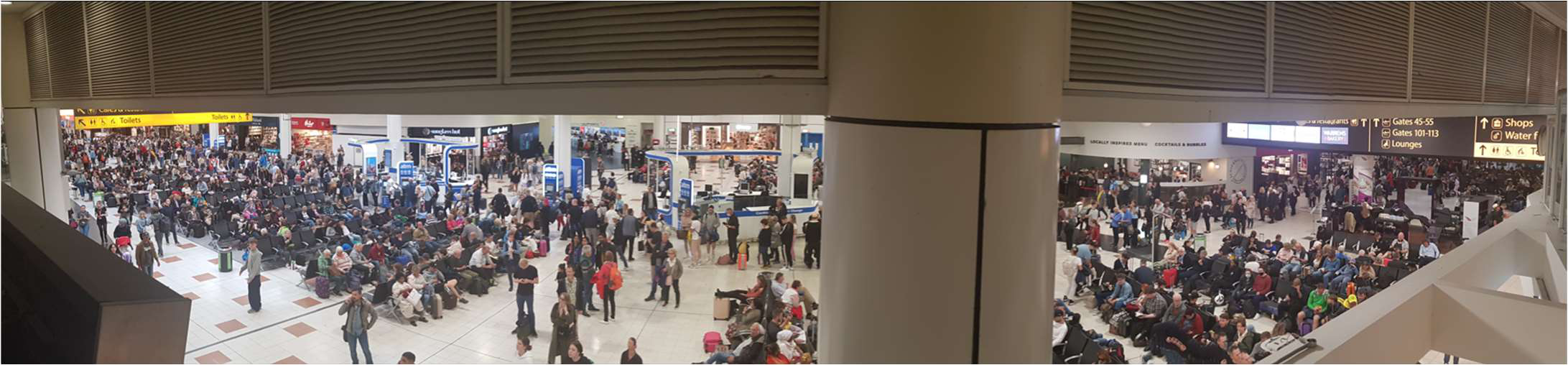
Gatwick 2022 – Welcome to the UK
The internet allows instant price comparison and we have become a price sensitive community. British Airways recently announced they want to return to being a premium brand, an ambition almost impossible once you lose your premium identity. People will pay up for goods and services that have a luxury reputation, but these cater to the affluent minority, or have a very clever marketing team to maintain the premium image whilst selling to the masses. As some luxury goods makers are finding out, there is some price sensitivity if you go too far. For most of us Scrimpflation is here to stay. The young generation won’t notice Scrimpflation so much, because to them it has always been like that. The older generation will miss the customer service values that are becoming extinct.
The other phrase is “the Contradiction Economy.” Many economies are shrinking whilst unemployment remains near its pre-pandemic low. Companies cannot keep up with demand, yet their share price is collapsing. When equities go down, bonds and gold usually go up – but not this time – a contradiction. Consumer sentiment is low, but sales are rising – a contradiction. People are leaving Jersey and there are hundreds of units of accommodation that will be completed shortly, yet the estate agents say the market won’t fall…….
Workers are scarce, in part because the baby boomers are retiring. Demographics point to an expanding retired community, supported by a shrinking workforce. Because of supply chain disruptions, inventories are reducing and inflation increasing. The central banks provided far too much liquidity into the economy during the lock-down, and now we will pay the price.
Firstly, we will see the excess liquidity removed from the economy, primarily through higher interest rates. Money that found itself its way into assets with no real value, such as cryptocurrency, will see those assets continue to collapse. The economic downturn will not seem like other economic downturns. Unemployment will remain low simply due to a declining labour force, and for twelve months or so many will not notice any meaningful difference in their living standards apart from the impact of inflation on their weekly costs. However, inflation will be silently eating into their long-term real spending power, and businesses will outsource, use technology, or remote work from other jurisdictions rather than pay rising staff costs due to inflationary increases. It will take a while for the current outstanding job vacancies to be filled, which shall give a false sense of security. And that’s the risk of the contradiction. Everything will seem OK, but underneath significant changes are taking place – which I’ll cover in future articles.
That does not mean that conditions are necessarily bad for equities, indeed following the recent falls prospects are actually very good for many of them. It is just a case of understanding that the world has changed significantly and continues to change. To stay ahead you need to be alert to these changes and understand them.
Ben Shenton Chartered FCSI Senior Investment Director