Article 33
The Fed pivot
Investment Strategist Peter Lucas discusses market concerns shifting from inflation to growth as central banks tighten policy. Easing inflation will ultimately set the scene for a change in Fed direction and an asset price recovery.
About a month ago I said that it would not be too long before the focus of Fed policy shifts from pushing down inflation to supporting growth (Return of stop-go, May 2022). Then, a couple of weeks back I said that the case for “decent-sized correction and well overdue correction in the oil price are building” (Cost of living crisis, June 2022). These two predictions were (and are) very much linked. The Fed is determined to get inflation down. In world of constrained supply that means killing demand with restrictive policy. This implies that, unless the Fed changes its mind, recession is all but inevitable. With confidence already sapped by high and rising prices, it has not taken much in the way of monetary tightening to get economic indicators close to or in recessionary territory. The University of Michigan consumer sentiment survey has fallen to its lowest recorded level, in a history that stretches back to the late 70s.
Unsurprisingly, the commodity markets have taken notice, with many now trading well below their 2022 highs. Most notably, the spot price of economically sensitive copper is now 25% below its record high posted in March. The oil price has been more resilient but is also down 10% from its recent high. These price declines have settled investors’ inflation fears and opened the way for a well overdue recovery in the bond market. By some measures, the US bond market was the most oversold since the early 80s.
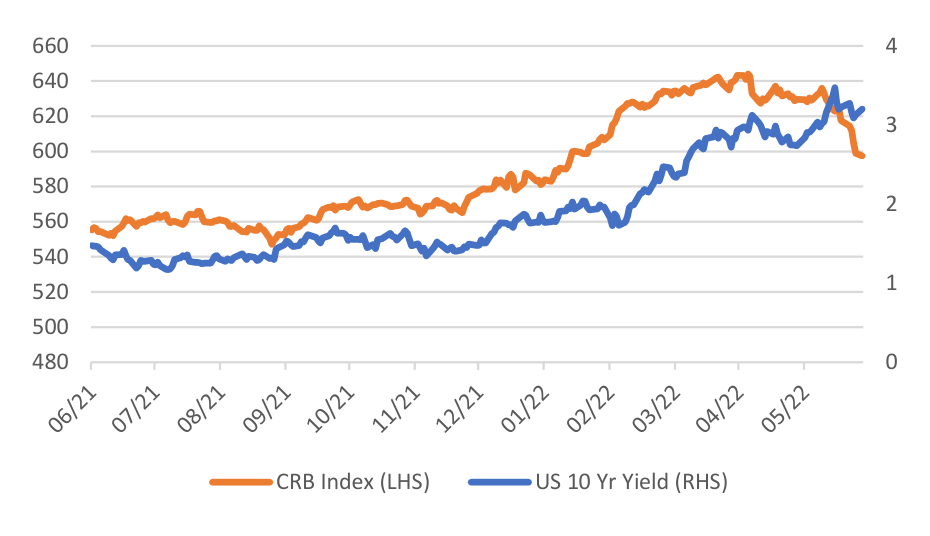
Equities were also sufficiently oversold and unloved to think that at least a short-term recovery was on the cards (as predicted back in May). We did see a bounce in late May but that soon petered out and gave way to another down leg in share prices. However, share prices are recovering again and with commodities and bond yields now trending lower, there is every reason to think that this recovery will prove to be a bit more durable. Furthermore, with bond yields now trending down, the likelihood is that it will be led by growth rather than value.
However, it is far from clear that this represents the beginning of a new bull market. The Fed is still saying that it is prepared to stay the course to get inflation back down to target. I still believe that the Fed will pivot to supporting growth before inflation gets down to 2%, but with oil still unchanged from March and up 60% year-on-year, and with inflation still at its high for the year, it is still too soon to think in those terms. The recession risks for the economy are real and growing. If analysts were to slash their earnings forecasts, it would open the way for another down leg in share prices. In short, the risk-reward for equities beyond the near term is still not great.
The outlook for bonds, particularly of the government variety, is more promising. The longer the Fed stays the tightening course, the grimmer the outlook will be for the economy. And government bonds like slowing growth and/or falling inflation. There is value in the corporate bond market, but in aggregate spreads are still not that wide by historical standards, particularly if we enter recession. How far could bonds recover? A typical 38-50% retracement of the 2021-22 bear leg in US bonds would see the 10-year yield fall to 2.30-2.59% (currently 3.17%) by October-November 2022. That seems a reasonable projection under the current circumstances.
In summary, the stock market rally has legs in the short-term, but downside risks will persist until we have clearer evidence of easing inflation pressures. My best guess is that oil will need to get down to $80-90 before the Fed will even think about relenting. In the meantime, government bonds and selected corporate bonds will be a safer place to invest. In addition, value should underperform growth for a while, having underperformed by 20-30% since last November. The correction in energy shares (a previous favourite) has further to run, in both absolute terms and relative to the S&P 500. Later this year the Fed will have to choose between getting inflation down to target and protecting jobs. My bet is that they will go with the latter, at which point equity market will enjoy a more protracted recovery, commodities will resume their long-term bull market and the countdown to another inflation crisis will begin.