Article 23
That Wile E Coyote moment
The US Dollar has been firm this year on the assumption inflation is transitory. Westminster Asset Management Investment Strategist Peter Lucas asks: ”What if it is not?”.
I last shared my thoughts on currencies back in February (“FX by the numbers”, February 2021). My medium-term view on the US dollar was negative but I cautioned against betting against it at the time given that there were just too many bears around, predicting that the greenback would enjoy a period of relief lasting weeks or even months. In the event, the US dollar has recovered, albeit that the rally has been more sideways than up: since bottoming at 89 in the New Year, the US dollar trade weighted index has moved hesitantly higher, reaching 93 by late August.
The US dollar is what many term a ‘risk-off’ currency. In other words, it tends to perform best when confidence is shot, and markets are in disarray. In that regard, it is not immediately obvious why it should have been strong of late. It’s not that there hasn’t been anything to worry about this year (think: COVID, China and inflation) but at the end of the day the S&P 500 is up over 16% year-to-date!
The pervasive dollar bearishness at the turn of the year was to a greater extent driven by optimism on markets and a belief that policy would remain accommodative for the foreseeable future. Much has changed in the past six months, largely due to inflation. Sharply rising prices have undermined confidence and prodded Central Bankers to consider tapering QE. Even so, it would be a stretch to describe the last six months as risk-off. Ultimately, the dollar recovery is probably as much about position-squaring as anything else. Indeed, stats that showed speculators heavily net short the dollar in January are now showing them to be net long. In short, this is a good time to revisit the longer-term bear case for the US dollar.
Despite inflation at multi-year highs, investors are relaxed. The Fed has assured them that inflation is ‘transitory’ – a consequence of temporary reopening pains – and they have bought into that narrative hook, line, and sinker. Furthermore, the imminent demise of China’s second largest property developer has got them thinking about the opposite problem, namely deflation. In short, we appear to be back in Goldilocks again – easy monetary policy combined with a (relatively) benign inflation outlook. For reasons that I have explained in earlier notes, I expect inflation to present markets with bigger problems in the years ahead, but for now, the outlook for risky assets remains set fair. This is not good news for the US dollar.
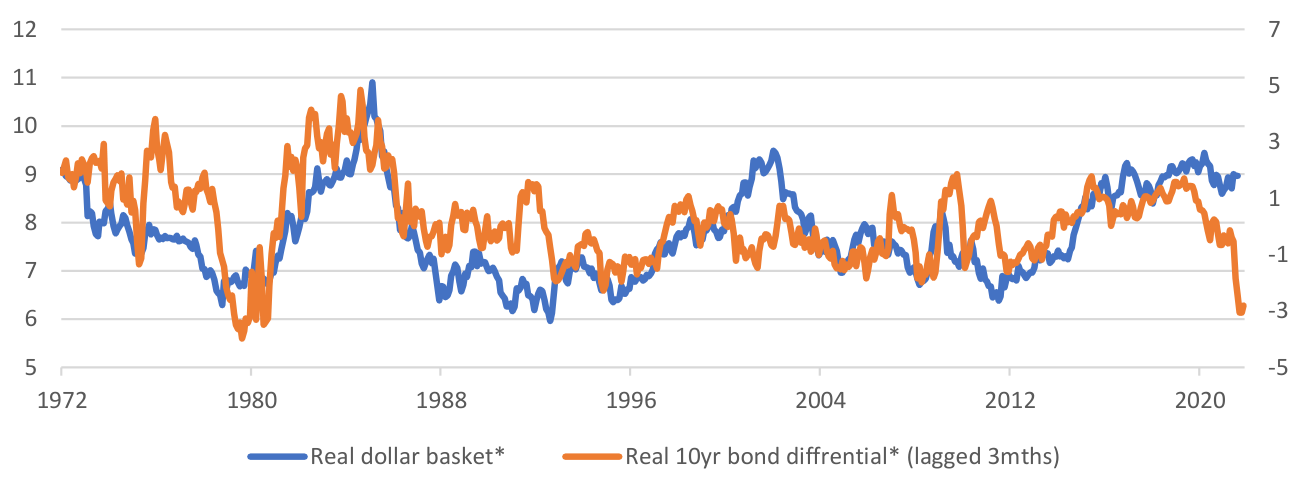
*versus GBP, JPY, SEK, CAD and CHF. Source: Bloomberg, Westminster Asset Management
The above chart shows the relationship between the US dollar and real bond yield differentials. The correlation is reasonable (58%), and the message is bearish. The US dollar basket is currently close to the high end of its 20-year range, but real bond yield differentials suggest that it should be nearer to the bottom.
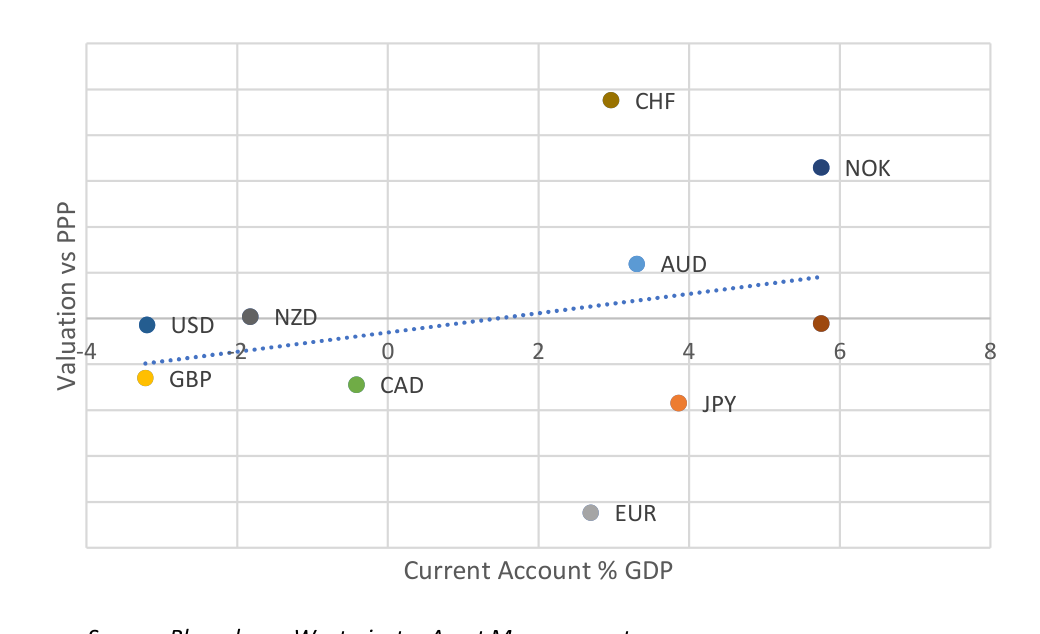
Developed world currency valuations (versus OECD PPP) have historically correlated quite closely with current account balances, with the currencies of big deficit countries trading well below PPP and vice versa. Right now, the correlation across the big economies is not as tight as it has been, nonetheless the message of the chart is worth noting, with the US dollar ranking eighth out of the big nine.
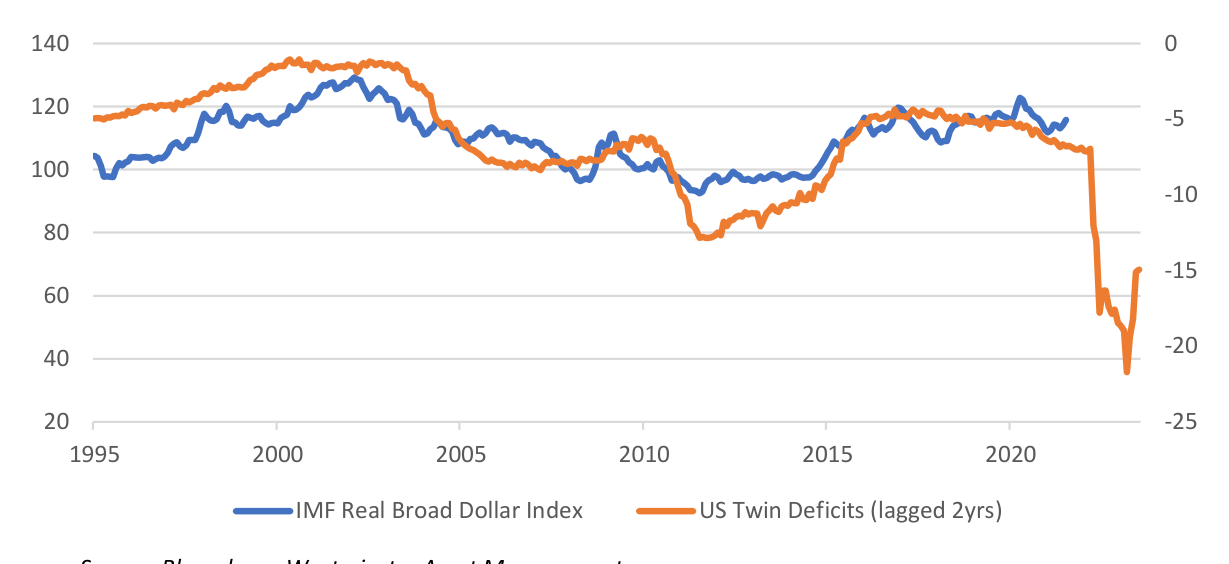
I have mixed feelings about the above chart which shows the historic relationship between the US twin deficits (the sum of the current account and fiscal balances) and the broad trade-weighted US dollar index. Currencies are supposed to be an expression of the relative merits of two economies, but this chart focuses solely on the US side. Nonetheless, the correlation is striking (80%), and the message of the chart is noteworthy, with the dollar projected to decline sharply in 2022.
In summary, the case against the dollar is six-fold:
- With fiscal and monetary policy likely to remain easy for the time being and with more countries learning to live with COVID, the environment should be good for risk assets but bad for the US dollar.
- Speculators are now net long the US dollar for the first time since March 2020.
- The dollar’s corrective rally looks complete on the charts.
- The US dollar is expensive in absolute terms and relative to its current account position.
- Real interest rates are very negative and suggest that the dollar should be much lower than its current level.
- And perhaps more controversially, the twin deficits project a much lower US dollar in the year ahead.
If the dollar is going to be weak, what does that mean for other assets, and which other currencies should we favour? A weaker dollar would do much to ensure that the current US inflation problem proves to be anything but transitory – it would feed imported inflation and the ongoing bull market in commodity prices. That might not be a problem for Wall Street today, but it almost certainly will be at some stage in the next year or so. Conversely, it should be good for emerging markets, which tend to like a weaker dollar. And as far as other currencies are concerned, one of the best all round packages is the euro, which is cheap and backed by a decent-sized current account surplus. The yen is also worthy of consideration. It may be another risk-off currency (or at least, it has been in the past), but it is now close to a 50-year low versus the US dollar on an inflation-adjusted basis and is currently very much out of favour with investors.