Article 22
Baked In the Cake
Westminster Asset Management Investment Strategist Peter Lucas looks past the short term inflation outlook and considers the evidence for the longer term outlook in the forecasts for the output gap and budget deficit.
Inflation matters. Correctly anticipating what it does can make a big difference to portfolio returns, and so I am compelled to revisit it again. In previous articles I have looked at the recent uptick in inflation and concluded that it could well be ‘transitory’, but whether that proves to be the case or not, it doesn’t matter because this year’s inflation may not be part of the longer-term inflation story. If inflation is going to be a problem, it will be because of bad policy making and deglobalization rather than supply chain problems and bottlenecks, and it will manifest itself over quarters and years rather than months. In today’s article I want to look at the inflation question from a different angle, examining its relationship with data published by the Congressional Budget Office (CBO). If the CBO is right about the output gap and the US budget balance, inflation is only going one way in the years ahead.
Research company Alpine Macro recently looked at some of the arguments championed by inflation camp, including the idea that big budget deficits lead to high inflation. Alpine Macro dismissed that argument on the basis that there is no obvious correlation between the United States’ budget deficit and its rate of inflation. They might need to look a little deeper.
Budget balances are inherently cyclical, shrinking in growth cycles and widening in recessions. The chart below demonstrates this quite well, with the US budget output correlating 57% with the output gap (the amount of spare capacity in the economy). This relationship can be used to cyclically adjust the budget balance to pick out times when it has been unusually big or small. Note that the resulting data series correlates 31% with year-ahead changes in inflation and has a 60% success rate in terms of picking the right direction of inflation changes in the period since 1968. The CBO has published its forecasts for the budget balance and the output gap for every year out to 2031. If correct, the budget deficit will be putting upward pressure on inflation for the next ten years.
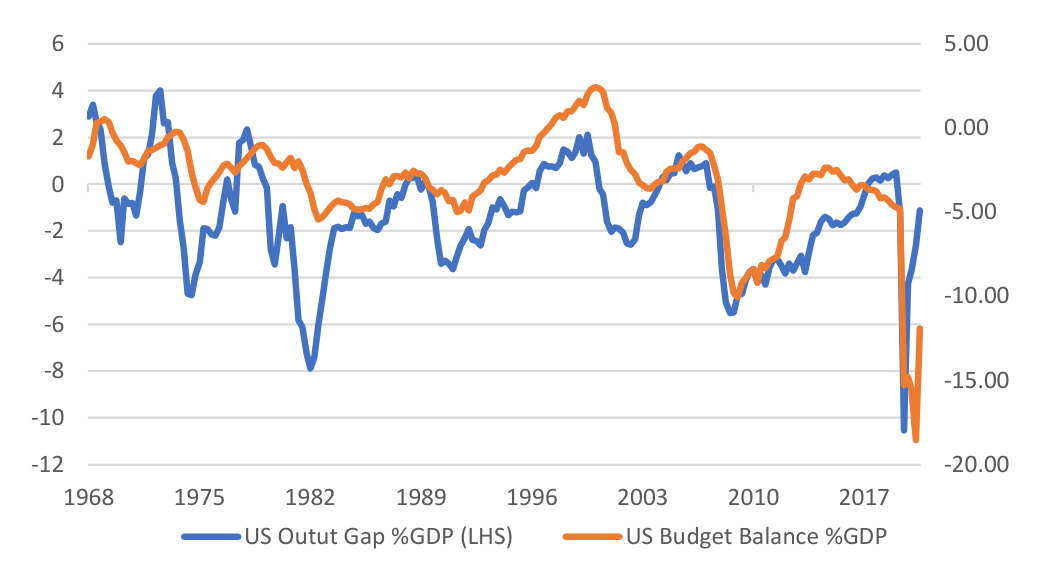
It is also interesting to note that the CBO says that the output gap will close by the end of this month and will remain positive until 2027. Historic data shows that a positive output gap is generally associated with rising inflation. Since 1968 the size of the output gap has correlated 47% with year-ahead changes in inflation and has correctly predicted the direction of change 65% of the time. Again, if they are right, the output gap will be pushing up inflation for the next six years.
If we regress changes in inflation on the cyclically adjusted budget balance and the output gap, we find that the resulting estimates of inflation changes correlate 54% with actual changes and the direction of change is correctly forecast in 74% of the time. And if we feed in the CBO’s forecasts for the two variables out to 2031, PCE inflation is shown accelerating gradually from 1.4% at the end of 2020 to 4.4% at the end of 2021 (it is already up to 3.6%), 8.9% by 2026 and 11.7% in 2031.
It has been said that God made economists to make weather forecasters look good. However, if the CBO’s numbers prove to be accurate, higher inflation is pretty much baked in the cake.