Article 15
FX by the Numbers
Investment Strategist Peter Lucas reviews his market views.
Currencies will likely prove to be something of a sideshow in an environment increasingly dominated by money printing, government largesse and market volatility. Nonetheless, my general view has been that Western currencies will weaken against Asian currencies and that the US dollar will weaken against other major currencies. The latter view has been bolstered by the Eurozone finally getting its act together (Germany spending money and the introduction of a regional fiscal budget) and the UK finally doing a trade deal of sorts with the EU. If there is one fly in the ointment, it is the fact that so many people are of the same view (more on that later). In this article I examine how these views are panning out, before sharing some statistics that are largely supportive of these positions.
My first outlook article for Westminster was distributed in July 2020 and since then the US dollar has weakened, despite a recovery since the New Year. Meanwhile Asian currencies like the yuan and the Singapore dollar have strengthened a little versus the euro. The pound has strengthened against most currencies due to the lifting of Brexit uncertainty.
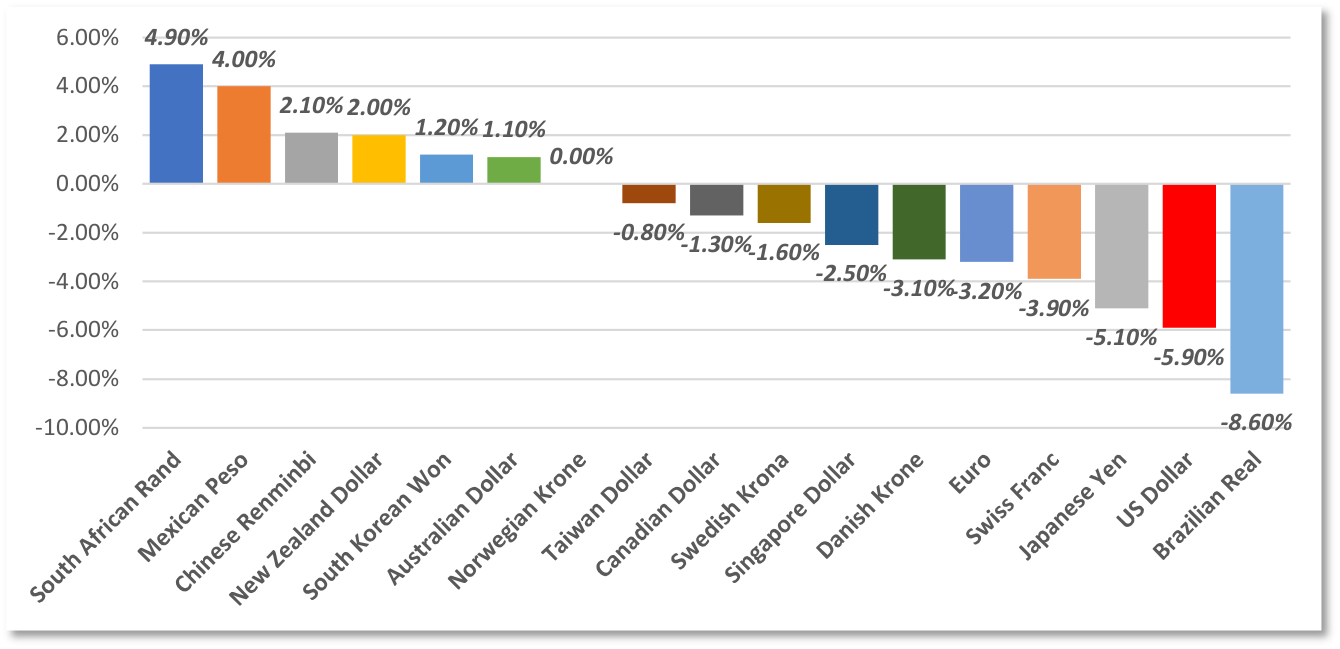
So, trends have roughly conformed to expectations, if not spectacularly. More recently, I have been uncomfortable about the fact that so many are now singing from the same hymn book. Everyone seems to expect the dollar to weaken as the vaccines as rolled out and economic conditions normalise. Of course, the consensus is not always wrong, but it has felt sufficiently one-sided for me to think that a counter-trend move was overdue. And that is essentially what we are seeing right now. For instance, the euro topped at $1.235 and is now just below $1.200. Having risen for nine months (March-January) it seems reasonable to think that the euro will experience a correction lasting another month or two. The most likely catalyst for such a move (rather than just position-squaring) is a jump in bond yields, which could draw money back to the US for a while. Beyond that, we should see a resumption of the weak dollar story. Incidentally, any signs of inflationary pressures in the West should also feed the strength in the currencies of Asia, which has not had to resort to extreme monetary and fiscal measures.
1 Publication date for “Current opportunities”, Westminster Asset Management
Sometimes it is good to step back from the noise of the markets and to take a high-level view. And when currencies are ranked against each other on several key metrics, a clear picture emerges. Let us start with valuation, in this case determined by the Economist’s Big Mac index (which compares the cost of a Big Mac across a range of countries):
| Currency | Value vs USD | Rank |
|---|---|---|
| Australian Dollar | -18.9% | 5 |
| British Pound | -23.9% | 3 |
| Canadian Dollar | -11.4% | 7 |
| Euro | -17.0% | 6 |
| Japanese Yen | -37.0% | 1 |
| New Zealand Dollar | -23.2% | 4 |
| Norwegian Krone | -1.8% | 8 |
| Singapore Dollar | -25.6% | 2 |
| Swedish Krona | -0.1% | 9 |
| Swiss Franc | +19.8% | 11 |
| United States Dollar | +0.0% | 10 |
Source: Bloomberg
International capital is often drawn to the currencies paying the best interest rates. Typically, it is nominal rates that matter most, but in a world of financial repression (interest rates being held below inflation) and rising inflation, it seems likely that greater attention will be paid to real interest rates, which should play well for Asian currencies.
| Currency | Deposit rates | Rank |
|---|---|---|
| Australian Dollar | -0.05% | 6 |
| British Pound | 0.10% | 4 |
| Canadian Dollar | 0.10% | 5 |
| Euro | -0.52% | 10 |
| Japanese Yen | -0.11% | 9 |
| New Zealand Dollar | 0.23% | 2 |
| Norwegian Krone | -0.09% | 8 |
| Singapore Dollar | 0.25% | 1 |
| Swedish Krona | -0.09% | 7 |
| Swiss Franc | -0.60% | 11 |
| United States Dollar | 0.12% | 3 |
Source: Bloomberg
The market and economic environment can have a significant bearing on currencies. One of the clearest examples as such is the Australian dollar, which has a strong positive correlation with industrial metals prices (which Australia produces in great quantities). This year is expected to be a year of rising equity and commodity markets. The next table shows the correlation of various currencies versus the S&P 500 and the prices of oil and industrial metals. In other words, the table highlights which currencies are most likely to thrive in the sort of environment that I envisage. The US dollar is generally thought of as a ‘risk-off’ currency, and this table confirms that status.
| Currency | Correlation2 | Rank |
|---|---|---|
| Australian Dollar | +0.47 | 1 |
| British Pound | +0.02 | 5 |
| Canadian Dollar | -0.13 | 7 |
| Euro | -0.09 | 6 |
| Japanese Yen | -0.43 | 10 |
| New Zealand Dollar | +0.36 | 2 |
| Norwegian Krone | +0.34 | 3 |
| Singapore Dollar | -0.36 | 9 |
| Swedish Krona | +0.29 | 4 |
| Swiss Franc | -0.29 | 8 |
| United States Dollar | -0.51 | 11 |
Source: Bloomberg
The size of the current account balance is also an important consideration. Currencies backed by a large positive current account balance generally trade on a premium versus their deficit counterparts.
| Currency | Current account3 | Rank |
|---|---|---|
| Australian Dollar | 1.9% | 7 |
| British Pound | -2.1% | 9 |
| Canadian Dollar | -1.7% | 8 |
| Euro | 2.0% | 6 |
| Japanese Yen | 3.0% | 4 |
| New Zealand Dollar | -2.2% | 10 |
| Norwegian Krone | 2.2% | 5 |
| Singapore Dollar | 16.3% | 1 |
| Swedish Krona | 5.2% | 3 |
| Swiss Franc | 7.6% | 2 |
| United States Dollar | -2.6% | 11 |
Source: Bloomberg
If I sum up the ranks and then rank again, it leaves us with the Singapore dollar (here taken as a proxy for Asia as a whole) as the number one currency and the US dollar as the least attractive. Sometimes it pays to keep things simple, and this rudimentary ranking approach leaves us with some clear conclusions, which as it happens, are very much in keeping with my core view on currencies this year.
In summary, the consensus view of a weak US dollar in 2021 will likely be proved correct, albeit that there is a good chance that the US dollar will experience an upwards correction in the next few weeks, most likely driven by rising US Treasury yields. And if inflation starts to raise its ugly head, it will merely serve to emphasise the low inflation credentials of Asian currencies.
2 Average 3-year correlation between a currency’s basket value and the S&P 500, the oil price, and the industrial metals index
3 Expressed as % of GDP