Article 14
The Year of Mean Reversion
Investment Strategist Peter Lucas reviews his market views.
It is the nature of markets that they overshoot. The hard bit is identifying when the elastic band is stretched to the limit, to the point that a long period of reversion to the mean (and beyond) can begin. There have been notable winners in the last few years – the US dollar, large cap growth, US equities to name but three – but in many cases valuations were close to historic extremes, thus indicating that mean reversion was at hand. All that was lacking was a catalyst, and then along came COVID.
Slowly but surely, the overvalued winners have been pushed off the podium by their undervalued counterparts. In March we saw a peak in the US dollar, as well as a low in US small cap versus large caps. Emerging markets bottomed versus developed markets in May. US equities topped out versus Japan in September and Europe in October. September also witnessed a low point of US value versus growth, a downtrend that has been in place with little interruption since 2007. In all but one case (value vs growth) longer term price averages are now trending higher. In short, what started as valuation stories are evolving into fully-fledged bull markets, supported by improving fundamentals and favourable momentum.
This is broadly in keeping with the game plan outlined last year (see “Current opportunities”, July 2020). However, there is one piece of the jigsaw that has not fully clicked into place. In that same July article, I said that “the top in government bond prices is only weeks or even days away”, and as it turned out, UK and US 10-year government bond prices peaked a couple of weeks later. However, you can keep the champagne on ice given that (a) European bond markets went on the hit new highs for the year and (b) bonds generally have hardly dropped out of bed. Even the worst performing market (the US) has only seen 10-year bond prices drop around 5% since August, which only represents a 30-40% retracement of the 2020 gains. Given that commodities and equities have retraced all their losses and then some, the bond sell-off has been muted to say the least. Furthermore, the stability in bond yields has meant that moves in other (bond sensitive) assets have also not been as big as expected. Growth shares (most notably technology) have only experienced mild underperformance of late and value shares (particularly financials) have yet to really fire on all cylinders.
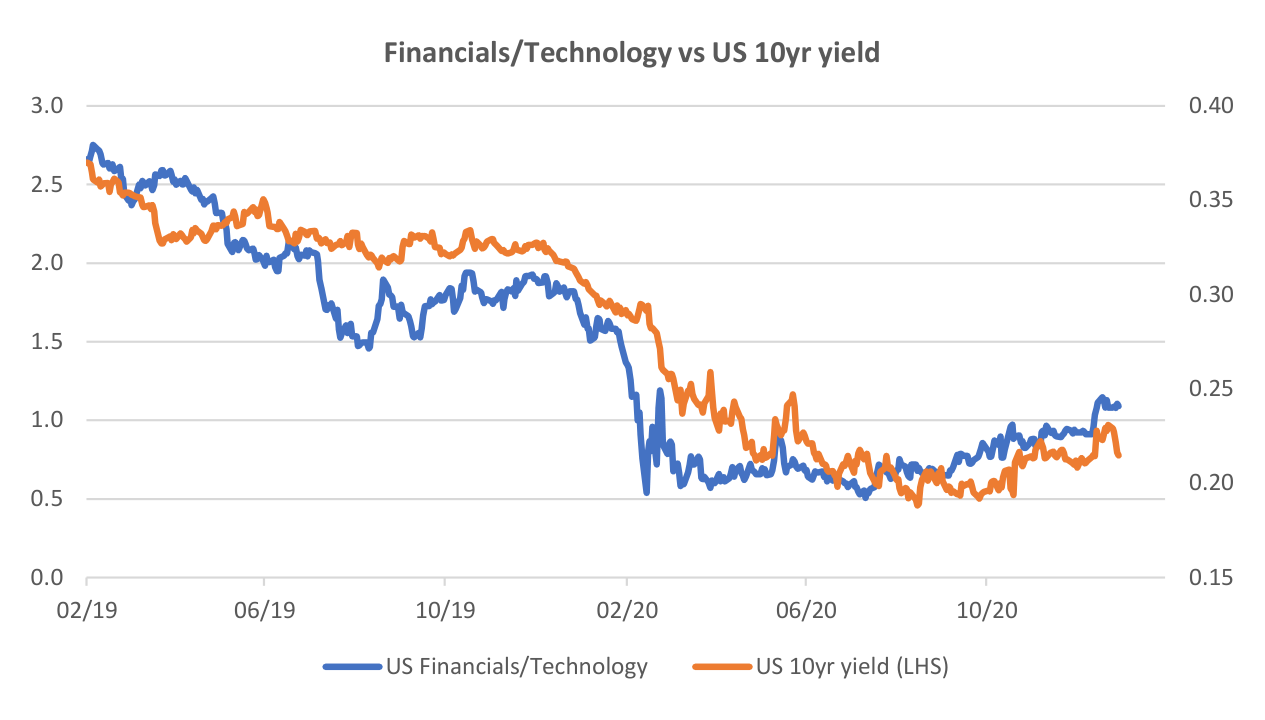
There are those that think the downside for bonds is limited given that (a) inflation will remain low for some time to come and (b) Central Banks have pledged to keep interest rate close to or below zero for the next year or two and (c) Central Banks will cap any rise in bond yields with more QE. Clearly, the first two points are linked. If inflation rises more than expected, then Central Banks might renegue on their pledge to keep interest rates down. The inflation optimists point to lots of business failures and high unemployment. However, this is not your normal recession. What we are seeing, courtesy of government largesse, is demand holding up and savings rates rising. When we emerge from this COVID fug, a wall of demand is going to hit a shortage of supply. That sounds inflationary to me, particularly when you add in other factors like rapid money supply growth and big fiscal deficits.
Indeed, if there is one area that I disagree with the consensus view, that otherwise looks worryingly like my own, it is the downside risk to government bonds. My sense is that investors are negative but not negative enough. Yield curves remain very flat, particularly in the context of very low real interest rates and have room to steepen quite a bit from here, particularly if inflation and bond volatility pick up from their current low levels. And if Central Banks try to cap bond yields in the presence of rising inflation, the resulting injection of liquidity into the markets will be akin to pouring petrol on a fire.
In summary, my view remains much as it was back in July. Markets are correctly sensing an end to the COVID crisis and there is good money to be made in 2021-2, particularly in cyclical and inflation assets like value shares, inflation-linked bonds, and commodities. However, I sense that the generally bullish consensus may be underestimating the downside to government bonds and that may lead to market volatility further down the track. And if Central Banks respond with more QE, watch out, because that is when the reflation/inflation story will go into overdrive.