Article 13
Treasury Yields-Do we have lift-off?
Investment Strategist Peter Lucas reviews the evidence for a turnaround in government bond yields.
The government bond market has been described as the nerdy older brother of the equity market – less prone to over-reaction and with a better track record of getting it right. So, what are we to make the very different responses of the two markets to the vaccine news? On the one hand equity markets have gone completely potty, enjoying one of their best months in decades, and on the other hand, bonds – which have been a major beneficiary of the COVID recession – have barely budged. Surely, one of them has got to be wrong and given its reputation, who would bet against the bond market? The short answer is, we would. And what’s more the price action is starting to confirm the bear case for government bonds.
We have laid out our negative view on bonds in previous articles, so today we want to look at the same issue from a different angle. Over the years there has been a close correlation between the copper/gold ratio (CGR) and the US 10- year Treasury yield. This makes sense because whilst copper is a very cyclical asset – rising and falling with the health of the global economy – gold is more of a safe-haven. In the past five years that relationship has been remarkably tight, with a correlation coefficient of 89%. However, what is striking about the situation today is that the divergence between the CGR and bond yields is as great as at any time in that five-year period. So, which side of that relationship is wrong? Are bond yields too low or is the CGR is too high?
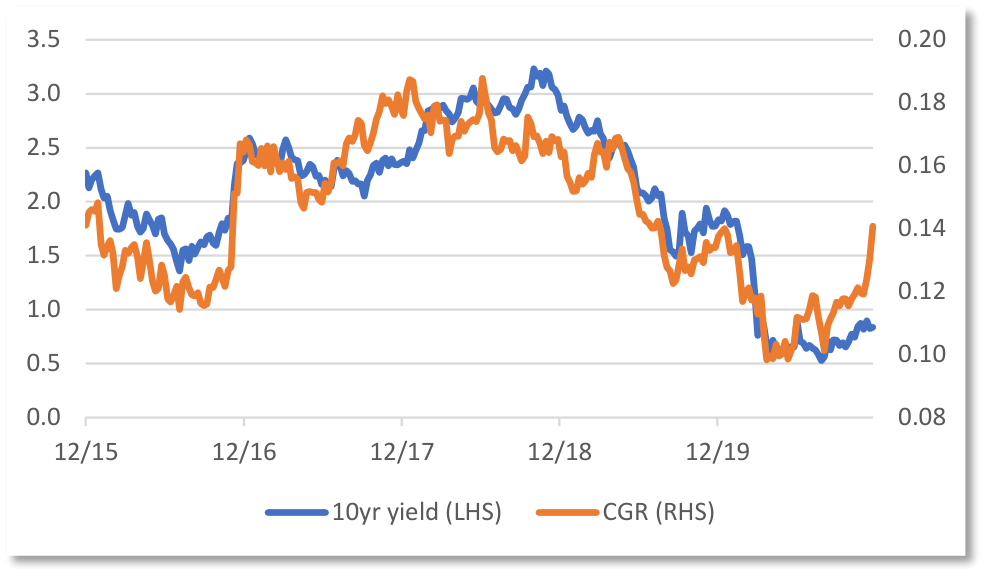
Chart 1: Copper/Gold Ratio vs 10 Year Treasury Yields % (Source: Bloomberg/Westminster Asset Management)
Before we address that question, consider another interesting correlation, namely that between the copper price and the MSCI China index. China is the biggest consumer of copper these days (and most other commodities for that matter) and hence when China thrives, the copper price tends to do the same. Indeed, the correlation between the copper price and the MSCI China Index in the past five years has been a very tight 85%. And according to that relationship the copper price is pretty much where it should be. That’s not to say that it can’t go down, but there is nothing there to suggest that it is significantly out of line with reality. Furthermore, when it comes to China and Asia more generally, we are inclined to optimism. That leaves us thinking that either bond prices are too high, or the gold price is too low.
Or it could be that both are wrong. Certainly, in the last few days we have seen gold rally and bond prices fall. The gap is being closed from both directions. Normally, gold doesn’t react well to rise bond yields and interest rates but, having already experienced a four-month correction and with bond yields rising from abnormally low levels, gold may prove to be more resilient this time around. Furthermore, given our expectations for inflation to rise in the medium term, gold is very much an asset to ‘buy on dips’.
One final and important observation on the CGR. Given its historical relationship with bond yields, its current level suggests that the US 10-year yield should be closer to 1.9% than its current level of 0.9%. If the yield were to rise to that level it would put it where it was at the start of the year, before the virus struck. Equities have retraced all their losses, so why not bond yields?
The copper-gold ratio is just one of many indicators that we track, but its message is very much in keeping with our core view that governments bond yields are about to rise, possibly sharply. What’s more, the recent price action suggests that might already be starting to happen. Do we have lift off? We are increasingly convinced that’s we do.